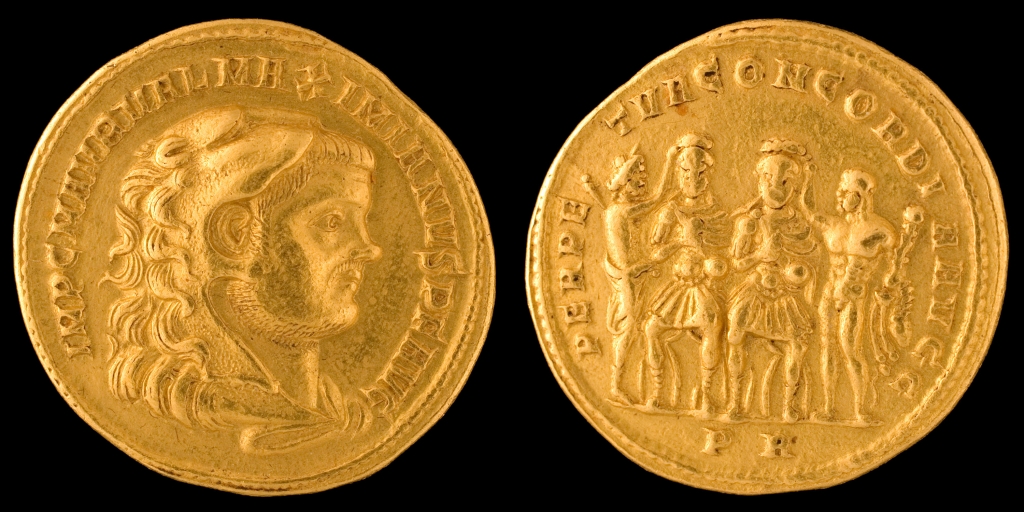
Gold 5 Aurei Medallion of Maximian, 5.29 g.
Title
Gold 5 Aurei Medallion of Maximian, 5.29 g.
Creator
Maximian
Date
293 CE
Description
Obverse: Maximian adorned with Hercules' lion skin; IMP C M AVR VAL MAXIMIANVS P F AVG.
Reverse: Diocletian and Maximian, Augustus and Caesar, sit, facing, draped and cuirassed, each holding globes in their left hands; in the right field Hercules stands, holding club and lion skin and crowns Maximian; in the left field Jupiter stands and crowns Diocletian; PERPETVA CONCORDIA AVGG, PR in exergue.
Style/Period: Roman Empire
Maximian was proclaimed co-emperor in the year 286 CE by Diocletian in order to help manage a fracturing empire. The artistic style of this coin reflects how the two emperors attempted to restore dominance through art and religion. The reverse is an image of the two emperors being crowned by Hercules and Jupiter. In the year 287 CE the emperors deified themselves to cement their power and tell the public that the emperors were holding power through divine authority. Diocletian made Jupiter, the king of the heavens, his patron, and Maximian made Hercules, the king of the earth, his patron. The reverse of the medallion shows this idea explicitly. The central figures are Maximian on right and Diocletian on the left, both being crowned by their respective patron gods. The figure on the right holds a club and has a lion-skin cap, both characteristic of Hercules. On the left stands Jupiter, with his lightning bolt and a crown. The emperors are larger than the deities, indicating that they are more powerful than even the gods themselves. Additionally, both of them are carrying a globe, further symbolizing domination over the earth. Diocletian and Maximan wanted to show that the two emperors ruled as equals. The inscription reads “CONCORDIA” or total cooperation with one another. Their rule was more than just two men ruling simultaneously, but two men acting as a single power. Both emperors are of equal height and have no distinguishing characteristics. Not long after this coin’s production, Diocletian would go on to form the Tetrarchy, where the same ideals of unity, lack of individuality, and divine authority were shared by four men.
The portrait on the obverse is of Maximian projecting his power in typical Tetrarchic fashion. The lion-skin cap furthers his association with Hercules, and his head is broad and blocky, with a very strong jaw, the face of a powerful man. The head is tilted slightly down, with big, deep-set eyes, almost as if looking down at the viewers from a throne, staring directly into them. Additionally, he has a military-style beard, showing that he has all the strength and discipline of a soldier.
--McKinley Breen, LU `21
Bibliography: C. Foss, Roman Historical Coins (London 1990), 250, 254; H. Cohen, Latin Epigraphy II: The Coin Inscriptions and Epigraphical Abbreviations of Imperial Rome (Chicago 1978), XX, XXXIX, XLV; J.P.C. Kent, Roman Coins (New York 1978), 46; L. Breglia, Roman Imperial Coins: Art and Technique (New York 1968), 204; J.M.C Toynbee, Roman Medallions (New York 1944), 205, 209.
Source
Former collection of Ottilia Buerger. Purchased from Harlan J. Berk, Chicago, IL
Identifier
2001.100
Rights
Wriston Art Center Galleries, Lawrence University, Appleton, WI,wriston-gallery@lawrence.edu,920-832-6890
''
Files
Citation
Maximian
, “Gold 5 Aurei Medallion of Maximian, 5.29 g.,” Lawrence University Classics Department & Ottilia Buerger Coin Collections, accessed November 5, 2026, https://thor.lawrence.edu/omeka/buerger/items/show/587.