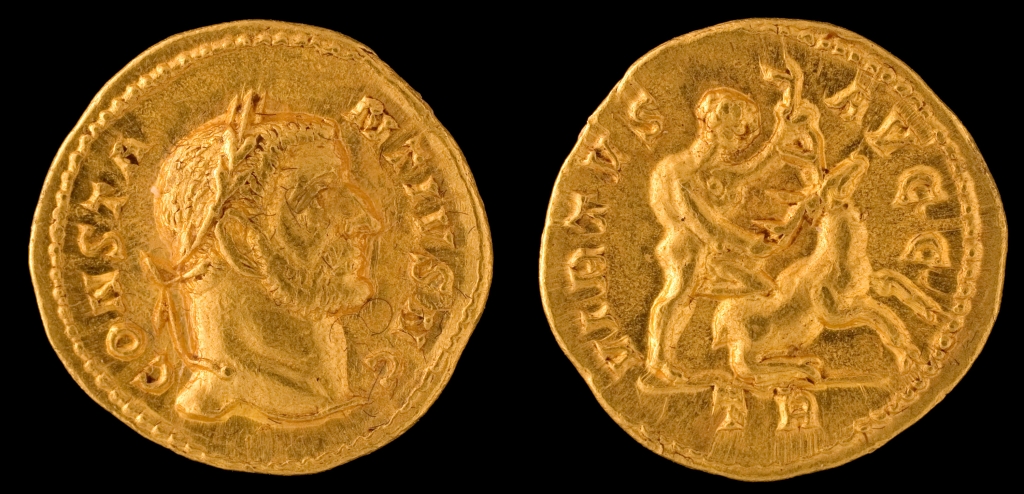
Gold Aureus of Constantius I, Trier, 5.33 g.
Title
Gold Aureus of Constantius I, Trier, 5.33 g.
Creator
Constantinus I
Date
295–296 CE
Description
Obverse: Laureate head of Constantinus I; CONSTANTIVS N C.
Reverse: Hercules wrestling a stag; VIRTVS AVGG; TR in exergue.
Style/Period: Roman Empire
This is a coin of Constantius Chlorus, known simply as Constantius I, who served as emperor from 293 CE to 306 CE, during a time known as the Tetrarchy. It was a period begun in 293 CE by Diocletian and his colleague Maximian, when four men ruled simultaneously in order to disperse the enormous burden of administering the empire. To assert their authority, the Tetrarchs used art and religion to propagate their message of unity and power. The obverse portrait of this coin shows how they used art to display unity by removing individualizing features of the emperors. The Tetrarchy’s philosophy was to have all four men rule as a single unified entity. If it were not for the inscription, there would be no way to identify the man in the portrait.
The reverse has an image of Hercules wrestling a stag. This image was used to associate the Tetrarchs to a mythological past, solidifying their dominance. The senior pair of the Tetrarchs made Jupiter, king of the heavens, their patron, while the junior pair used Hercules, king of the earth, as their patron. The two senior Tetrarchs were called Augusti and the junior Tetrarchs were called Caesars. At the time of this coin’s production, Constantius was a Caesar with Hercules as his patron. And yet, by declaring “VIRTVS AVGG,” which means “courage of the Augusti,” he is deferring power to his superiors and reaffirming their divinity. Through its imagery this coin propagates the idea that the Tetrarchy is a stable, singular enterprise that is endorsed by the gods themselves.
--McKinley Breen, LU `21
Bibliography: D. Kleiner, Roman Sculpture (New Haven 1992), 400-401; C. Foss, Roman Historical Coins (London 1990), 263; H. Cohen, Latin Epigraphy II: The Coin Inscriptions and Epigraphical Abbreviations of Imperial Rome (Chicago 1978), XIX, XXI; C.H.V. Sutherland and R.A.G. Carson, The Roman Imperial Coinage, Vol. VI (London 1967), 173.
Source
Former collection of Ottilia Buerger. Purchased from Harlan J. Berk, Chicago, IL
Identifier
2001.099
Rights
Wriston Art Center Galleries, Lawrence University, Appleton, WI,wriston-gallery@lawrence.edu,920-832-6890
''
Files
Citation
Constantinus I, “Gold Aureus of Constantius I, Trier, 5.33 g.,” Lawrence University Classics Department & Ottilia Buerger Coin Collections, accessed November 5, 2026, https://thor.lawrence.edu/omeka/buerger/items/show/586.