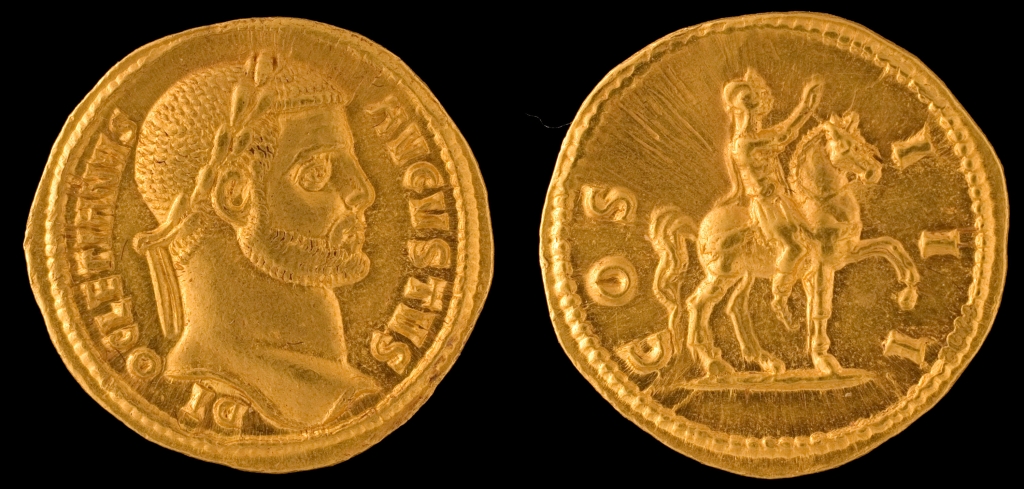
Gold Aureus of Diocletian, Cyzicus, 5.29 g.
Title
Gold Aureus of Diocletian, Cyzicus, 5.29 g.
Creator
Diocletian
Date
287–290 CE
Description
Obverse: Diocletian in profile view, with a laureate head. DIOCLETIANVS AVGVSTVS: Diocletian Augustus.
Reverse: Equestrian Diocletian, with right hand raised; COS III.Consul for the third time.
Style/Period: Roman Empire
Diocletian was proclaimed emperor in 284 CE and ruled for over 20 years before abdicating in 305 CE. He came to power at the end of a great political upheaval in the Roman empire. In order to prevent the empire from slipping back into anarchy, he took measures to ensure that the empire would return to a strong central government. Among these was sharing control of the empire between four men, called the Tetrarchs, distributing the enormous burden of administration. He also transferred power into the Roman army, and the emperors were in direct control of the military, transforming the empire into a military dictatorship. This coin shows his reliance on that military infrastructure. The reverse has an image of Diocletian on horseback in a pose that is highly reminiscent of a general leading his troops. This would show the army that he is their leader, and the people that he is in direct command of the military. The COS III is a celebration that he was elected consul for the third time. At this point the Senate had virtually no power, and Diocletian’s role as a consul is indicative that the last vestiges of the Roman republic had been swept away.
His portrait on the obverse shows how the Tetrarchy used art to project its power. Diocletian’s head is rectangular, and his eyes are large and deep-set. His chin is very pronounced, and he sports a military-style beard. Anyone who looked at the coin would see the face of a very powerful, disciplined man who is not to be crossed. Meanwhile, the beard further solidifies his connection with the military. In addition, to show the political unity of the Tetrarchy, there are almost no distinguishing characteristics between Diocletian and other Tetrarchs. If not for the inscription, there would be no way to tell that it is actually Diocletian. This was to show that the Tetrarchy was not four men ruling together, but four men acting as a single unified entity.
--McKinley Breen, LU `21
Bibliography: D. Kleiner, Roman Sculpture (New Haven 1992), 400-401; C. Foss, Roman Historical Coins (London 1990), 250-251; J.P.C Kent, Roman Coins (New York 1978), 48; L. Breglia, Roman Imperial Coins: Art and Technique (New York 1968), 202.
Source
Former collection of Ottilia Buerger. Purchased from Harlan J. Berk, Chicago, IL
Identifier
2001.098
Rights
Wriston Art Center Galleries, Lawrence University, Appleton, WI,wriston-gallery@lawrence.edu,920-832-6890
''
Files
Citation
Diocletian, “Gold Aureus of Diocletian, Cyzicus, 5.29 g.,” Lawrence University Classics Department & Ottilia Buerger Coin Collections, accessed November 5, 2026, https://thor.lawrence.edu/omeka/buerger/items/show/585.