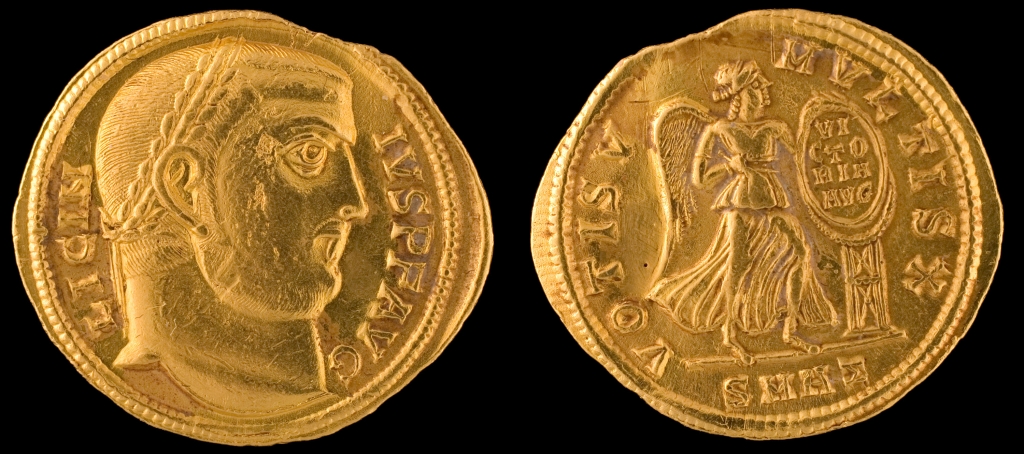
Gold Aureus of Licinius, 5.17 g.
Title
Gold Aureus of Licinius, 5.17 g.
Creator
Licinius I
Date
313 CE
Description
Obverse: Laureate head of Licinius in profile view. LICINIVS P(IVS) F(ELIX) AVG(VSTVS). Licinius pious and happy Augustus
Reverse: Image of Victory setting a shield on a pillar. Inside the shield, VICTORIA AVG(VSTVS): Victorious Augustus. VOTIS V MVLTIS X: 5 years of rule and 10 years more. In exergue: SMAƐ, mint mark for Antioch
Style/Period: Roman Empire
Licinius was made an emperor in 308 CE and ruled until deposed by his co-emperor Constantine in 324 CE. He originally ruled during an era known as the Tetrarchy, where control of the empire was shared between four men. However, the Tetrarchy collapsed during the civil wars of the Tetrarchy, when Licinius and his co-emperor Constantine took control of the entire empire. Constantine eventually deposed Licinius some years later, but until that point the two split control of the empire, Licinius in the west, and Constantine in the east. The obverse shows a very distinct image of Licinius. His eyes are large and deep-set, and he has a very heavy, almost square jaw. Additionally, the face is looking down, as if looking down from the throne at onlookers. This is representative of late Roman portraiture, when the eyes of the emperors became bigger and the figures larger than life. Emperors were losing power and used art to assert dominance and prolong their illusion of control.
The reverse of this coin is a representation of a vota, a celebration of the emperor’s reign, and a prayer for its continuance. This particular coin was minted in 313 CE as a commemoration of the 5th year of Licinius’ reign and the vota celebration that came with it. The “VICTORIA AVG” and statue of Victory represent Licinius’ triumph in the civil wars that propelled him to become emperor.
--McKinley Breen, LU '21
Bibliography: D. Kleiner, Roman Sculpture (New Haven 1992), 400, 406-407; C. Foss, Roman Historical Coins (London 1990), 270-272; H. Cohen, Latin Epigraphy II: The Coin Inscriptions and Epigraphical Abbreviations of Imperial Rome (Chicago 1978), XLV; J.P.C Kent, Roman Coins (New York 1978), 55, 327-328; L. Breglia, Roman Historical Coins: Their Art and Technique (New York 1968), 210.
Source
Former collection of Ottilia Buerger. Purchased from Abner Kreisberg, September 9, 1960.
Identifier
91.241
Rights
Wriston Art Center Galleries, Lawrence University, Appleton, WI,wriston-gallery@lawrence.edu,920-832-6890
''
Files
Citation
Licinius I, “Gold Aureus of Licinius, 5.17 g.,” Lawrence University Classics Department & Ottilia Buerger Coin Collections, accessed November 5, 2026, https://thor.lawrence.edu/omeka/buerger/items/show/584.