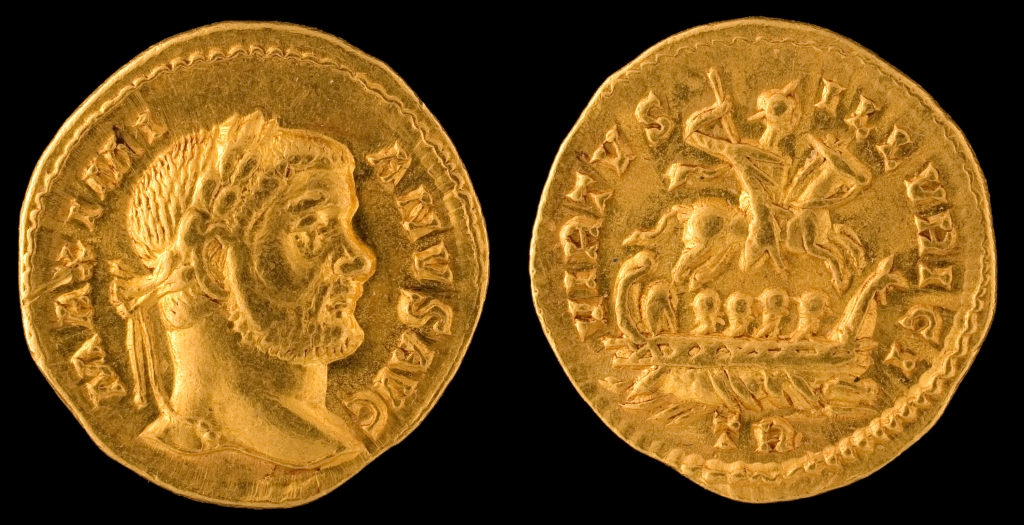
Gold Aureus of Maximian, Trier, 26.90 g.
Title
Gold Aureus of Maximian, Trier, 26.90 g.
Creator
Maximian
Date
295–305 CE
Description
Obverse: Laureate head of Maximian; MAXIMIANVS AVG.
Reverse: Prince galloping, spear downwards, above galley with four rowers; VIRTVS ILLVRICI; TR in exergue.
Style/Period: Roman Empire
The obverse shows the Emperor Maximian, who ruled from 286 CE to 305 CE, during an era known as the Tetrarchy, when the empire was ruled by four men simultaneously in order to distribute the enormous burden of ruling the empire. To assert their power they frequently used art and portraiture such as the bust of Maximian featured on this coin. His head is blocky, with a staunch face and aloof expression, sporting a military-style beard, harkening back to his days in the army. Anyone who gazed upon the face would have seen a powerful, disciplined man. Additionally, there are almost no distinguishing characteristics of his face, as part of the Tetrarchy’s propaganda was that the four men were indistinguishable and ruled as one.
The reverse depicts a victory of Maximian’s Tetrarchy over the rebel Carausius, who had taken Britain and northern France from the empire a decade prior. Maximian managed to take the mainland parts of Carausius’ kingdom back and invaded the island of Britain in 289 CE but failed to take it. In 296 CE a junior Tetrarch named Constantius launched an invasion, finally bringing Britain back into the fold. The ship with rowers signifies the role the navy had in invading Britain. The man on horseback with a spear shows the bravery of Constantius in leading his men during the fighting outside of modern-day London. The inscription “VIRTVS ILLYRICI” means “Army of Illyricum,” thus praising Constantius and the Tetrarchy as a whole, as most of the Tetrarchs, including Maximian, hailed from the province of Illyria.
--McKinley Breen, LU `21
Bibliography: D. Kleiner, Roman Sculpture (New Haven 1992), 400-401; C. Foss, Roman Historical Coins (London 1990), 250-251, 254-255; J. P. C. Kent, Roman Coins (New York 1978), 324; S. Williams, Diocletian and the Roman Recovery (New York 1992), 43-45, 64, 71.
Source
Former collection of Ottilia Buerger. Purchased from Harlan J. Berk, Chicago, IL
Identifier
2001.101
Rights
Wriston Art Center Galleries, Lawrence University, Appleton, WI,wriston-gallery@lawrence.edu,920-832-6890
''
Files
Citation
Maximian, “Gold Aureus of Maximian, Trier, 26.90 g.,” Lawrence University Classics Department & Ottilia Buerger Coin Collections, accessed November 5, 2026, https://thor.lawrence.edu/omeka/buerger/items/show/588.