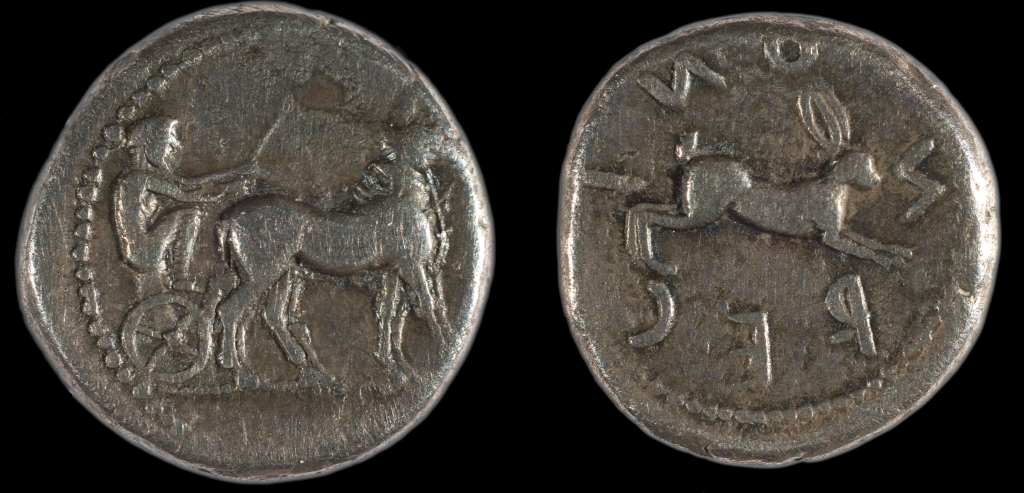
Silver drachm of Rhegion (Rhegium), 4.31 g.
Title
Silver drachm of Rhegion (Rhegium), 4.31 g.
Creator
Rhegion, (Rhegium), Bruttium, Italy
Date
c. 480-466 BCE
Description
Obverse: Mule cart being driven to right by bearded charioteer
Reverse: Running hare; RECINON retrograde: Rhegion
Style/Period: Early Classical Greece
Anaxilas was tyrant of Rhegium in 494 BCE. When the Samians fled Samos after the failed Ionian revolt, Anaxilas enlisted them to invade Zankle. The invasion was a success, and after taking the city, Anaxilas expelled the Samians and renamed the city “Messana” after his home Messene in the Peloponnese. Anaxilas and his family ruled the two cities as tyrants until their expulsion in 461 BCE, and both cities produced joint issues of coins.
This coin is a victory coin. Between the years 480 and 413 BCE, beginning with the defeat of Carthage and ending with the failed Athenian expedition, victory coins were being struck around Sicily. Most depicted fast-moving chariots, but this drachm depicts a mule cart on the obverse, perhaps because, according to Aristotle (fr. 578R), Anaxilas won an Olympic victory with a mule cart. Aristotle also explains the hare on the reverse, claiming that Anaxilas introduced hares into Sicily. This claim has been interpreted to mean that he actually did introduce the animal, or that he introduced these coins, popularly known as ‘hares’ (on analogy with the ‘owls’ produced by Athens), but since the hare appears with the god Pan on later coins of Messana, the hare may refer to the cult of Pan that was brought to Messana and Rhegion by the Messenians who originally settled Messana.
-- Chris Fuelling, LU '16
Bibliography: C. M. Kraay, Archaic and Classical Greek Coins (Berkeley and Los Angeles 1976) 214-215
Source
Former collection of Ottilia Buerger. Bought from Edward Gans, June 12, 1959
Identifier
91.020
Rights
Wriston Art Center Galleries, Lawrence University, Appleton, WI,wriston-gallery@lawrence.edu,920-832-6890
Files
Citation
Rhegion, (Rhegium), Bruttium, Italy, “Silver drachm of Rhegion (Rhegium), 4.31 g.,” Lawrence University Classics Department & Ottilia Buerger Coin Collections, accessed November 5, 2026, https://thor.lawrence.edu/omeka/buerger/items/show/360.