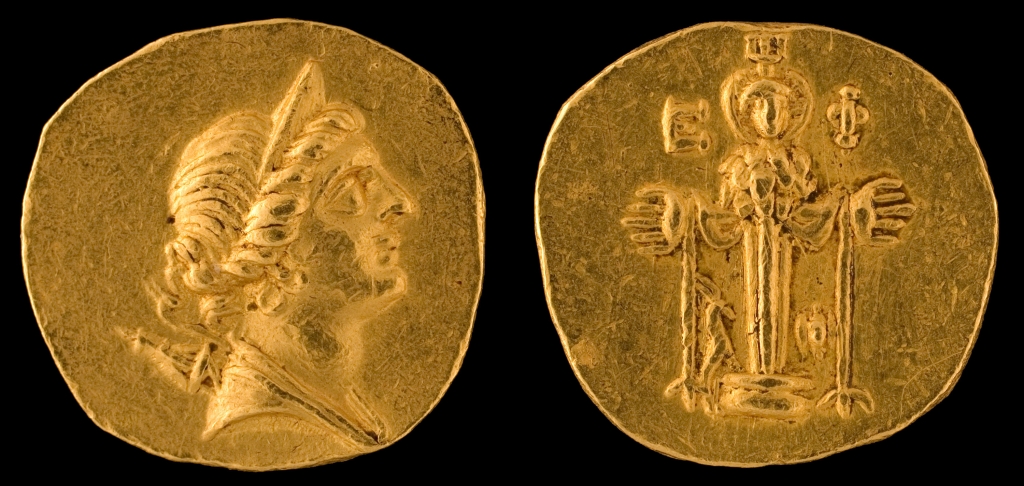
Gold Stater of Ephesos (Ephesus), 8.46 g.
Title
Gold Stater of Ephesos (Ephesus), 8.46 g.
Creator
Ephesos (Ephesus)
Date
c. 87-84 BCE
Description
Obverse: Draped bust of Artemis wearing stephane and quiver over left shoulder.
Reverse: Polymastoid cult statue of Artemis of Ephesos, wearing polos, wreath around head, arms spread and propped up by three-footed supports; to left of feet, a stag; to right of feet, a bee. On either side of head, Ε Φ: Ephesos.
Style/Period: Hellenistic
This coin of Ephesos, a city of ancient Ionia, was probably issued to commemorate the revolt of the province of Asia from Rome in 88-84 BCE. Unlike the Ephesian coins that preceded it, the coin bears no Roman magistrate’s name, and instead patriotically refers to the city’s main claim to fame, its Temple of Artemis, one of the seven wonders of the ancient world. Originally built in the mid-6th century BCE and rebuilt after a disastrous fire in the 4th century BCE, the temple housed a famous cult statue, which is depicted on this coin to advertise the city’s independence from Rome.
The obverse of the coin depicts the city’s patron deity as a huntress, with her quiver over her left shoulder. On the reverse is the famous cult statue, whose many-breasted form probably refers to her association with fertility. She stands with libations pouring from her huge outstretched hands. The turreted polos on her head represents the city’s walls. On the base of the statue are a stag and a bee. The stag refers to Artemis the huntress. The bee is a symbol associated with Artemis at Ephesos; her priestesses were called by the title Melissa or “Bee.” On either side of her head are Greek letters abbreviating the name of the city.
-- Frederick Breslow, LU ‘11
Bibliography: B. V. Head, Historia Numorum: A Manual of Greek Numismatics (1911, Chicago reprint 1967) 576; G. W. Elderkin, “The Bee of Artemis,” American Journal of Philology 60 (1939) 203-213; O. Mørkholm, Early Hellenistic Coinage from the Accession of Alexander to the Peace of Apamea (336-188 B.C.) (Cambridge 1991) 25-26, fig 657.
Source
Former collection of Ottilia Buerger. Purchased from Harlan J. Berk, Chicago, IL
Identifier
2001.089
Rights
Wriston Art Center Galleries, Lawrence University, Appleton, WI,wriston-gallery@lawrence.edu,920-832-6890
Files
Citation
Ephesos (Ephesus), “Gold Stater of Ephesos (Ephesus), 8.46 g.,” Lawrence University Classics Department & Ottilia Buerger Coin Collections, accessed November 5, 2026, https://thor.lawrence.edu/omeka/buerger/items/show/361.