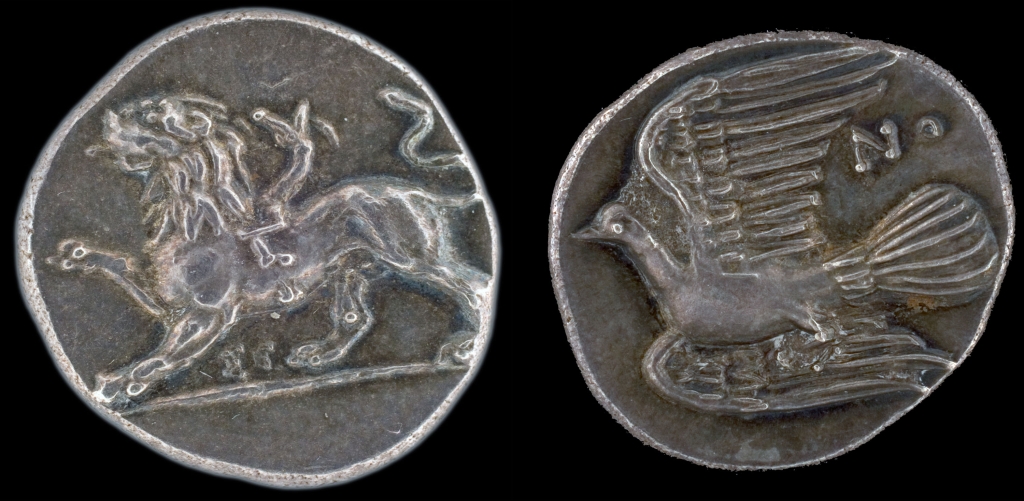
Silver Hemidrachm of Sikyon, 2.87 g.
Title
Silver Hemidrachm of Sikyon, 2.87 g.
Creator
Sikyon (Sicyon), Greece
Date
c. 400-323 BCE
Description
Obverse: Chimaera to left; below, ΣΙ: Sikyon abbreviated
Reverse: Dove flying to left; Νο in right field
Style/Period: Late Classical Greece
Located not far from Corinth on the Corinthian Gulf, Sikyon was a wealthy city famous for its sculptors and painters. With the decline of Aeginetan coinage after the Athenian conquest of Aegina in 431 BCE, Sikyon became one of the major Peloponnesian mints until the time of Alexander the Great.
The chimaera on the obverse is a fire-breathing monster with the forepart of a lion, the middle part a she-goat, her head rising from its back, and the tail of a serpent. Its significance on the coinage is not certain, but it has been suggested that, since it was a creature that endangered Sikyon’s frequent enemy, Corinth, it was taken up as a symbol of their rivalry.
The dove on the reverse is an attribute of Aphrodite, who had a sanctuary in Sikyon and whose chryselephantine cult statue by the sixth-century sculptor Kanachos was one of the principal monuments of the city (Pausanias, Description of Greece II.10.4).
-- Rebecca H. Luhmann Levine, LU '93
Bibliography: B. V. Head, Historia Numorum : A Manual of Greek Numismatics (1911, Chicago reprint 1967) 409-412; A Catalogue of the Coins in the British Museum: Peloponnesus (Bologna 1963) 46, no. 118; C. M. Kraay, Archaic and Classical Greek Coins (Berkeley and Los Angeles 1976) 98-99.
Source
Former collection of Ottilia Buerger. Ex Lockett collection. Purchased from Edward Gans, September 25, 1959
Identifier
91.072
Rights
Wriston Art Center Galleries, Lawrence University, Appleton, WI,wriston-gallery@lawrence.edu,920-832-6890
Files
Citation
Sikyon (Sicyon), Greece, “Silver Hemidrachm of Sikyon, 2.87 g.,” Lawrence University Classics Department & Ottilia Buerger Coin Collections, accessed November 5, 2026, https://thor.lawrence.edu/omeka/buerger/items/show/358.