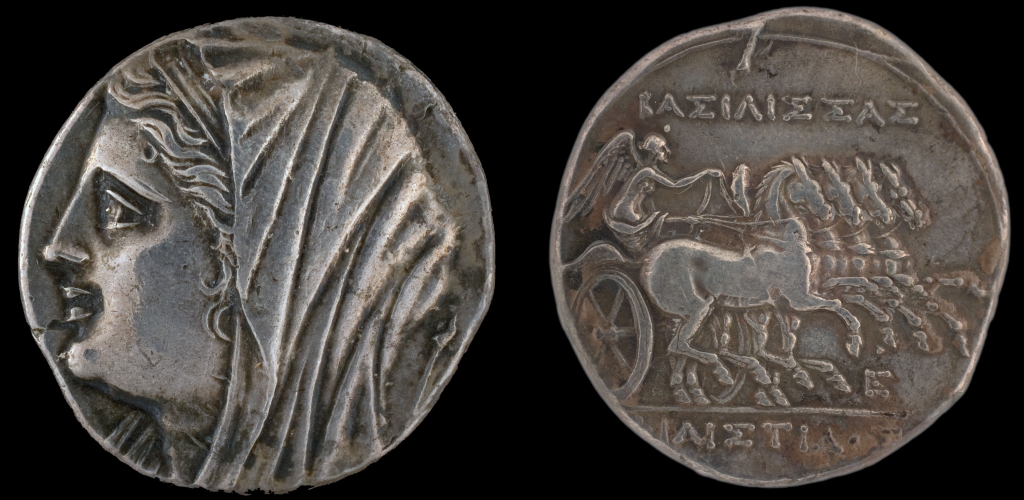
Silver 16 litrai of Syracuse, 13.27 g.
Title
Silver 16 litrai of Syracuse, 13.27 g.
Creator
Syracuse, Sicily, Italy
Date
c. 269-215 BCE
Description
Obverse: Veiled and diademed head of Queen Philistis to left; flaming torch in field at right.
Reverse: Nike in racing quadriga to right; beneath horses’ legs, Ε; ΒΑΣΙΛΙΣΣΑΣ ΦΙΛΙΣΤΙΔ[ΟΣ]: of Queen Philistos.
Style/Period: Hellenistic
Hieron II ruled over a peaceful period in Syracusan history. In 269 BCE, he and his wife Philistis took the royal title and diadem. Hieron issued a very large series of this denomination, featuring a portrait of his wife.
Although the head on the obverse is generalized and ideal, it should be considered a portrait of Queen Philistis because her name is on the reverse. The portrait was probably modeled on the dekadrachms of Ptolemy II of Egypt, which depicted his wife Arsinoë with a very similar veil and diadem. The coins were also issued on the Ptolemaic weight standard, and it seems likely that Hieron intended to compare himself and his queen to the rulers of the Ptolemaic dynasty.
The reverse depicts a racing quadriga reminiscent of the quadrigas on the reverses of the great late-fifth-century Syracsuan coins (see coins 91.032 91.033). The Hellenistic coin shows a greater understanding of perspective, which was still being worked out in the Classical coins.
-- Kelly Swett Riordan, LU '93
Bibliography: Catalogue of the Greek Coins in the British Museum: Sicily (Bologna 1963) 213, no. 552; P. R. Franke, “Historisch-numismatische Probleme der Zeit Hierons II von Syracus,” Jahrbuch für Numismatik und Geldgeschichte 9 (1958) 57-85.
Source
Former collection of Ottilia Buerger. Purchased from Edward Gans, March, 1959
Identifier
91.040
Rights
Wriston Art Center Galleries, Lawrence University, Appleton, WI,wriston-gallery@lawrence.edu,920-832-6890
Files
Citation
Syracuse, Sicily, Italy, “Silver 16 litrai of Syracuse, 13.27 g.,” Lawrence University Classics Department & Ottilia Buerger Coin Collections, accessed November 5, 2026, https://thor.lawrence.edu/omeka/buerger/items/show/357.