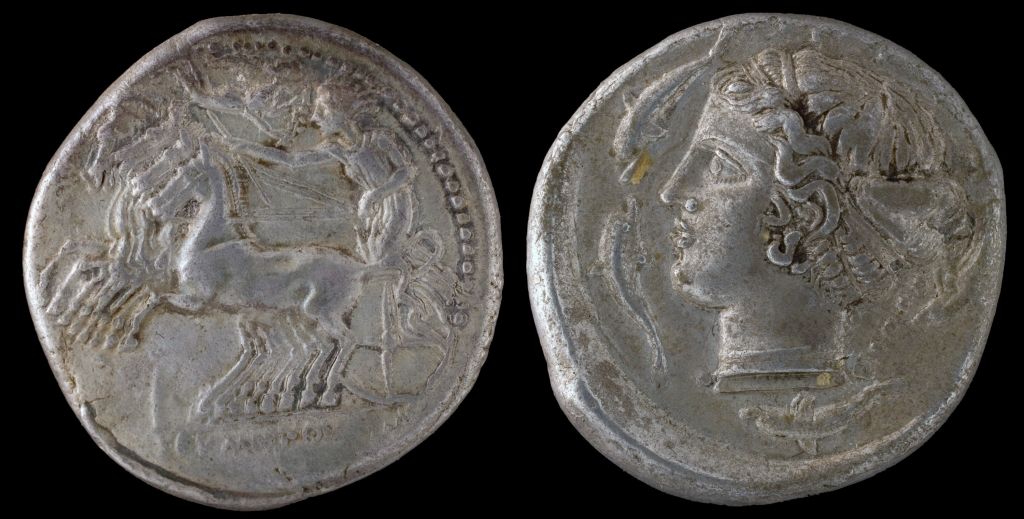
Silver Tetradrachm of Syracuse, 43.16 g.
Title
Silver Tetradrachm of Syracuse, 43.16 g.
Creator
Syracuse, Sicily, Italy
Date
c. 425-415 BCE
Description
Obverse: Quadriga racing to left, its male charioteer crowned by Nike flying overhead. In exergue, signature of the die engraver, ΕΥΜΗΝΟΥ: Eumenes.
Reverse: Head of Arethusa to left, surrounded by four dolphins; to right of head, ΕΥΜΗΝΟΥ.
Style/Period: Greek (Classical)
The obverse depicts a racing quadriga, a chariot pulled by four horses. Victorious quadrigas are commonly depicted on the coins of Syracuse because the Gamoroi, the Syracusan aristocracy, had a great interest in racing this type of chariot in the Olympic games. The image of the quadriga was adopted by many other cities in Sicily. In this period, die engravers for Syracuse frequently signed their dies. The dies for both the obverse and reverse of this coin were signed by Eumenes.
The nymph Arethusa is depicted in profile on the reverse of the coin. In mythology, Arethusa, a worshiper of the goddess Artemis, was pursued by the river god Alpheios. Arethusa escaped into the sea with the aid of Artemis and reemerged on the Syracusan island of Ortygia, where she was transformed into a fresh water spring that still flows next to the sea. Arethusa often appears on coins from Syracuse, encircled by dolphins that symbolize the sea surrounding Ortygia (see also coins 91.029, 91.032, 91.033, 93.007).
Max Lavery, LU '17
Bibliography: F. B. Tarbell, “Eumenes or Eumenos?,” Classical Philology 8 (1913) 230-231; G. E. Rizzo, Monete greche della Sicilia (Rome 1946), 201, no. 12, pl. 42; K. Jenkins, Ancient Greek Coins (New York 1972) 159-160; K. Jenkins, Coins of Greek Sicily (London 1976) 33-34.
Source
Former collection of Ottilia Buerger. Purchased from Harlan J. Berk, Chicago, IL
Identifier
2001.078
Rights
Wriston Art Center Galleries, Lawrence University, Appleton, WI,wriston-gallery@lawrence.edu,920-832-6890
Subject
Greek, quadriga, horse, charioteer, Nike, Arethusa, dolphins, Syracuse, Sicily, Italy
Files
Citation
Syracuse, Sicily, Italy, “Silver Tetradrachm of Syracuse, 43.16 g.,” Lawrence University Classics Department & Ottilia Buerger Coin Collections, accessed November 5, 2026, https://thor.lawrence.edu/omeka/buerger/items/show/342.