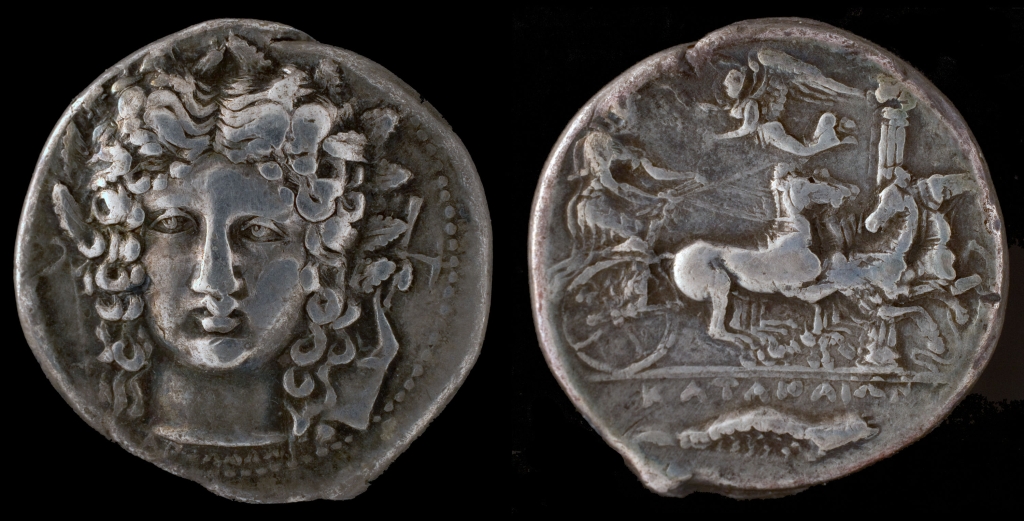
Silver Tetradrachm of Katane (Catana), 16.94 g.
Title
Silver Tetradrachm of Katane (Catana), 16.94 g.
Creator
Katane, Sicily
Date
c. 415-404 BCE
Description
Obverse: Facing head of Apollo with laurel wreath; strung bow to the left; kithara to right, hidden behind head; beneath neck, ΑΠΟΛΛΩΝ: Apollo.
Reverse: Quadriga with male charioteer racing to right past Ionic column, charioteer holding reins in both hands and goad in right; Nike flying to left above and holding wreath; crayfish to right in exergue. ΚΑΤΑΝΑΙΩΝ: of the Katanians.
Style/Period: Greek (Classical)
The city of Katane was colonized in the eighth century BCE by the people of Sicilian Naxos, itself a colony of Chalkis. Katane adopted Apollo, the patron deity of Chalkis, as its own patron deity. The tyrant Hieron of Syracuse moved the inhabitants of Katane and Naxos to the city of Leontinoi in 476 BCE. The people of Katane returned to their city in 461, following the tyrant’s death.
The facing head of Apollo is shown on the obverse, the depiction clearly influenced by the famous facing heads on Syracusan coins of the time (see coins 93.007 and 93.005). The die for the obverse may have been signed by the engraver Choirion (ΧΟΙΡΙΟΝ) on the upper left side (Rizzo, fig. 24), but the coin was struck off-center, cutting off the inscription. Apollo’s head is crowned with laurel and flanked by his other attributes, behind and to the right of the head a kithara and behind and to the left, a strung bow. On the reverse, a quadriga races past a column while Nike crowns the charioteer. The choice of scene once again reveals the influence of Syracusan imagery, as racing quadrigas are commonly depicted on the obverses and reverses of Syracusan coins (see coins 91.029, 91.032, 91.033, 93.005, 93.007). The crayfish in the exergue is probably a local species.
-- Max Lavery, LU '17
Bibliography: G.E. Rizzo, Monete greche della Sicilia (Rome 1946) 111-112, fig. 24, pl. 14, no. 13; A Catalogue of the Greek Coins in the British Museum II: Sicily (Bologna 1963) 47, no. 34; C. M. Kraay, Archaic and Classical Greek Coins (Berkeley and Los Angeles 1976) 224-225.
Source
Former collection of Ottilia Buerger. Purchased from Harlan J. Berk, Chicago, IL
Identifier
2001.077
Rights
Wriston Art Center Galleries, Lawrence University, Appleton, WI,wriston-gallery@lawrence.edu,920-832-6890
Subject
Greek, Apollo, bow, lyre, quadriga, horse, charioteer, Ionic column, Nike, charioteer,cray-fish, Syracuse, Sicily, Italy
Files
Citation
Katane, Sicily, “Silver Tetradrachm of Katane (Catana), 16.94 g.,” Lawrence University Classics Department & Ottilia Buerger Coin Collections, accessed November 5, 2026, https://thor.lawrence.edu/omeka/buerger/items/show/341.