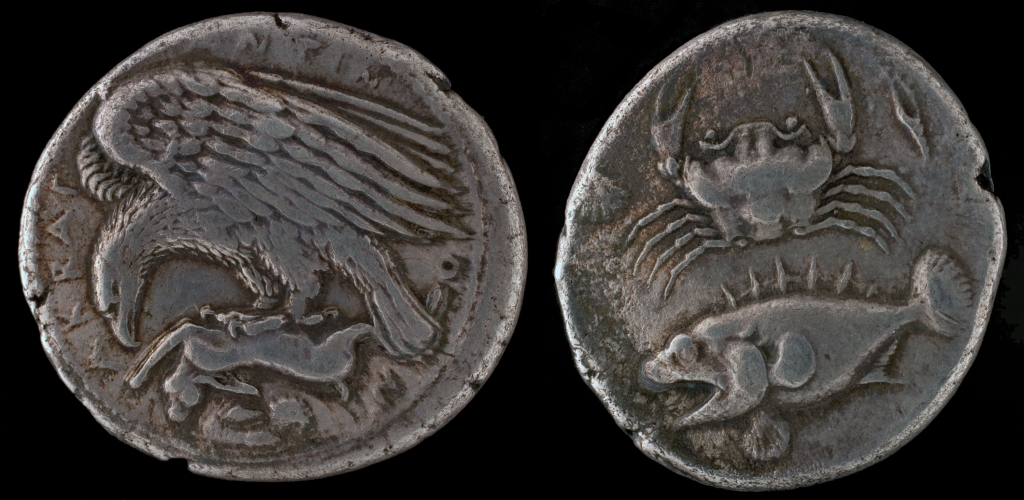
Silver Tetradrachm of Akragas, 17.12 g.
Title
Silver Tetradrachm of Akragas, 17.12 g.
Creator
Agrigentum (Akragas), Sicily, Italy
Date
c. 420-415 BCE
Description
Obverse: Eagle with spread wings standing on supine hare and devouring it; below, cockle shell. ΑΚΡΑΓ ΑΝΤΙΝ Ο Ν: of Akragas.
Reverse: Crab and broad sea fish with open mouth and spines along its back; on either side of crab, cockle shell and conch.
Style/Period: Greek (Classical)
Beginning with the early coins of Akragas, the typical obverse type depicted an eagle, a symbol of Olympian Zeus, who was an important deity in Akragas. Later, a type depicting two eagles feasting on a hare became popular (see coins 93.010, 2001.080) and may have originated as a tribute to the Greek playwright Aeschylus, who had died in 456 BCE in the nearby city of Gela; Akragas had been founded in c. 580 BCE as a colony of Gela. In Aeschylus’ Agamemnon, Zeus sends a sign of two eagles devouring a pregnant hare to Agamemnon. An augur interpreted this sign to mean that the brothers Agamemnon and Menelaus would sack Troy (Aeschylus, Agamemnon, 109ff). Strangely, the artist decided to depict only one eagle on the coin, seemingly mixing the earlier type with the imagery that had become more common when this coin was issued.
On the reverse, the die-engraver depicted a crab in the middle, flanked by a cockle shell on the left and a conch on the right. The crab was probably a type found in the local river or the sea and became a symbol of Akragas. Below the crab is a large fish, which has been identified as a mero or cernia, species found in the area.
Max Lavery, LU '17
Bibliography: A Catalogue of the Greek Coins in the British Museum II: Sicily (Bologna 1963) 11, no. 59; F. E. Zeuner, “Fish on Ancient Coins,” The Numismatic Circular 71, 1963, 142-143; C. M. Kraay, Greek Coins (New York 1966), 296, no. 173, pl. 60; K. Jenkins, Coins of Greek Sicily (London 1976) 46-47; C. M. Kraay, Archaic and Classical Greek Coins (Berkeley and Los Angeles 1976) 226, pl. 46, no. 793; N. K. Rutter, The Greek Coinages of Southern Italy and Sicily (London 1997) 149, fig. 162.
Source
Former collection of Ottilia Buerger. Purchased from Harlan J. Berk, Chicago, IL
Identifier
2001.079
Rights
Wriston Art Center Galleries, Lawrence University, Appleton, WI,wriston-gallery@lawrence.edu,920-832-6890
Subject
Greek, eagle, hare, barleycorn, scallop shell, crab, broad sea fish, conch, Agrigentum, Akragas, Sicily, Italy
Files
Citation
Agrigentum (Akragas), Sicily, Italy, “Silver Tetradrachm of Akragas, 17.12 g.,” Lawrence University Classics Department & Ottilia Buerger Coin Collections, accessed November 5, 2026, https://thor.lawrence.edu/omeka/buerger/items/show/343.