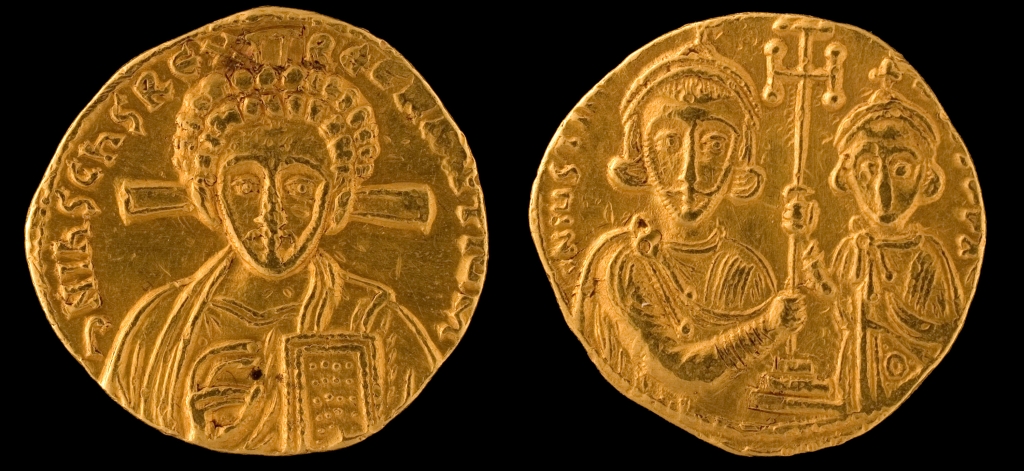
Gold Solidus of Justinian II and Tiberius, 4.27 g.
Title
Gold Solidus of Justinian II and Tiberius, 4.27 g.
Creator
Justinian II, Tiberius
Date
705-711 CE
Description
Obverse: Facing bust of Christ with curly hair, cross behind head, right hand raised in blessing, left holding Gospel book; D(OMINVS) N(OSTER) IhS(VS) Ch(RISTV)S REX REGNANTIVM: Our Lord Jesus Christ, Ruler of those who rule.
Reverse: Facing half-figures of Justinian on left and Tiberius on right, each wearing crown and chlamys, holding between them cross potent on base; D(OMINI) N(OSTRI) IVST[INIANVS ET TIBERIVS] P(ER)P(ETVI) A(VGVSTI): Our lords Justinian and Tiberius, perpetual Augusti.
Style/Period: Byzantine
Justinian II, who first came to power in 685 CE, was mutilated and ousted by Leontius in 695 CE (see 91278), but after ten years in exile "the emperor without a nose," so nicknamed as a result of his mutilation, returned to the throne for a second reign. In his first reign Justinian, a devout Christian, had taken the important step of depicting Christ on a coin for the first time and establishing the convention in which the image of Christ on the obverse displaced the portrait of the emperor to the reverse of the coin. In addition, the legend on the obverse proclaims that the emperor is subject to Christ the King. The image of Christ was not used by the emperors immediately following Justinian, but it was later revived, and its position on the obverse determined the relationship between Christ and the emperor on all later Byzantine coins.
In his second reign Justinian retained the image of Christ on the obverse, but the type has changed from the stern, long-haired, fully bearded figure of the Pantokrator common in Byzantine icons and mosaics to a youthful, curly-haired Christ with a short beard, a type thought to be derived from Syrian depictions of Christ.
For most of his second reign, Justinian ruled in association with his young son, Tiberius, who is pictured with him on the reverse, his youth and junior status indicated by his scale and position on the right. Together they hold the cross potent on a stepped base, which formerly had been the standard reverse type. Justinian was ruthless in exacting revenge upon his many enemies, and in the end both he and his young son were murdered.
-- Rebecca K. Browning Wojcik, LU '93
Bibliography: P. Grierson, Byzantine Coins (London 1982).
Source
Former collection of Ottilia Buerger. Purchased from Coin Galleries, 1959.
Identifier
91.280
Rights
Wriston Art Center Galleries, Lawrence University, Appleton, WI,wriston-gallery@lawrence.edu,920-832-6890
Subject
Byzantine, Christ, Gospel, Justinian II, Tiberius, chlamys, cross, cross potent
Files
Citation
Justinian II, Tiberius, “Gold Solidus of Justinian II and Tiberius, 4.27 g.,” Lawrence University Classics Department & Ottilia Buerger Coin Collections, accessed November 5, 2026, https://thor.lawrence.edu/omeka/buerger/items/show/327.