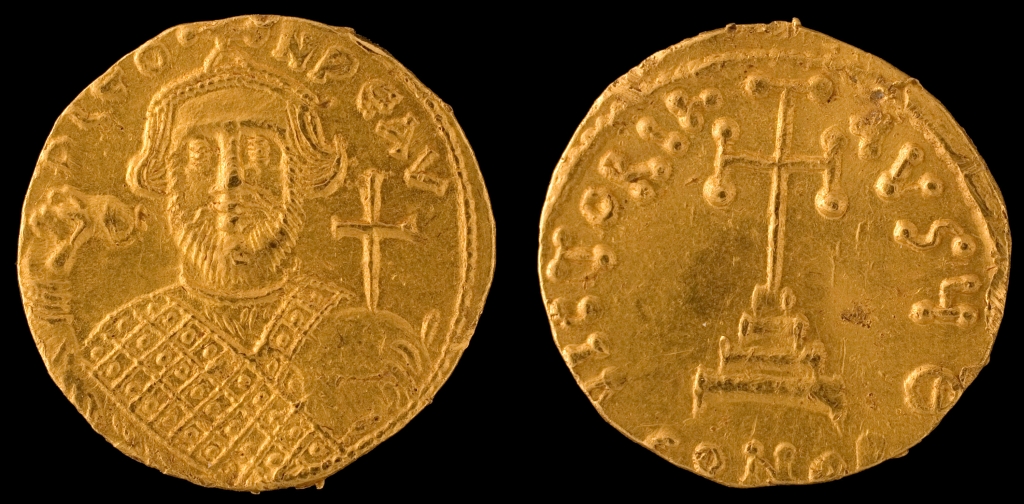
Gold Solidus of Leontius, 4.45 g.
Title
Gold Solidus of Leontius, 4.45 g.
Creator
Leontius
Date
695-698 CE
Description
Obverse: Facing bust of Leontius, wearing loros and crown and holding akakia in right hand and globus cruciger in left; D(OMINVS) LEON(TIVS) PE(RPETVVS) AV(GVSTVS): Lord Leontius, perpetual Augustus.
Reverse: Cross potent on steps; VICTORIA AVGV(STI) Y: Victory of the Augustus, officina mark Y; in exergue, CONOB: gold of Constantinople.
Style/Period: Byzantine
Leontius usurped the throne from Justinian II in 695 CE. He was unable to put down Arab attacks on Carthage in northern Africa, however, and he was deposed three years later. Although his reign introduced a long period of instability, in which five emperors rose and fell in twenty years, his coins are masterpieces of detail in the imperial dress.
On the obverse a robust, bearded Leontius wears the loros, an elaborately jeweled and embroidered scarf wrapped around the body somewhat like a toga, thrown first over the left shoulder, then pulled under the left arm, brought across the front of the body, thrown over the right shoulder and pulled across the back to the left hip, pulled across the front of the body again, and then draped over the right arm (see 91.287). In his right hand he holds an akakia, a symbol first adopted by Leontius and used in many imperial portraits afterwards. It was a short cylinder with jeweled ends containing dust, intended to remind the emperor that even he was mortal.
On the reverse, Leontius reverts to the cross potent on steps that was introduced by the coins of Tiberius Constantine as a reference to the cross on the hill of Calvary (see 91.272).
-- Rebecca K. Browning Wojcik, LU '93
Bibliography: P. Grierson, Byzantine Coins (London 1982).
Source
Former collection of Ottilia Buerger. Purchased from Coin Galleries, March 1959.
Identifier
91.278
Rights
Wriston Art Center Galleries, Lawrence University, Appleton, WI,wriston-gallery@lawrence.edu,920-832-6890
Subject
Byzantine, Leontius, loros, crown, akakia, globus cruciger, cross, steps
Files
Citation
Leontius, “Gold Solidus of Leontius, 4.45 g.,” Lawrence University Classics Department & Ottilia Buerger Coin Collections, accessed November 5, 2026, https://thor.lawrence.edu/omeka/buerger/items/show/326.