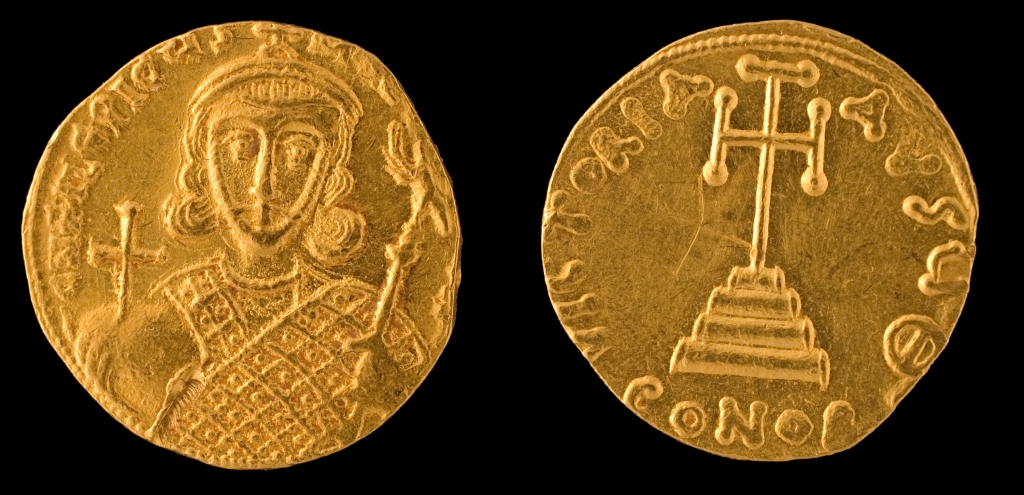
Gold Solidus of Philippicus (Bardanes), 4.33 g.
Title
Gold Solidus of Philippicus (Bardanes), 4.33 g.
Creator
Philippicus (Bardanes)
Date
711-713 CE
Description
Obverse: Facing crowned bust of Philippicus, wearing loros and holding globus cruciger in right hand and scipio in left; D(OMINVS) N(OSTER) FILEPICVS MV[LTOS ANNOS]: Our lord Philippicus, many years.
Reverse: Cross potent on four steps; VICTORIA AVGV(STI) Θ: Victory of the Augustus, officina mark Θ; in exergue, CONOB: gold of Constantinople.
Style/Period: Byzantine
In the course of the revolts that brought down Justinian II, an Armenian named Bardanes was proclaimed emperor; he changed his name to Philippicus. Philippicus subscribed to heretical views and made himself an enemy of the Pope by removing an image of a council of the Church that had condemned these views some years earlier. In the destruction of this religious image he foreshadowed the greater iconoclastic controversies to come, which were ignited by opposition to the cult of icons, or images of religious figures, and the superstitious practices they could encourage. These beliefs probably also led Philippicus to reject the bust of Christ that Justinian II had introduced to Byzantine coinage and to revert to the portrait of the emperor on the obverse of his coins and the cross on the steps on the reverse.
The portrait of Philippicus introduces a somewhat longer hairstyle for the emperor, but is otherwise as stylized as those of his predecessors. This is the last time that the scipio, the eagle-tipped consular scepter that he holds in his left hand, appeared on Byzantine coins. The acclamation multos annos, "may he rule for many years," was used at imperial processions and ceremonies and replaced perpetuus augustus on the coins of this period.
-- Rebecca K. Browning Wojcik, LU '93
Bibliography: W. Wroth, Catalogue of the Imperial Byzantine Coins in the British Museum (London 1908) 6; P. Grierson, Byzantine Coins (London 1982).
Source
Former collection of Ottilia Buerger. Purchased from Hesperia Art, Feb. 9, 1959.
Identifier
91.281
Rights
Wriston Art Center Galleries, Lawrence University, Appleton, WI,wriston-gallery@lawrence.edu,920-832-6890
Subject
Byzantine, Philippicus, loros, globus cruvieger, scipio, cross, cross potent, steps, Bardanes
Files
Citation
Philippicus (Bardanes), “Gold Solidus of Philippicus (Bardanes), 4.33 g.,” Lawrence University Classics Department & Ottilia Buerger Coin Collections, accessed November 5, 2026, https://thor.lawrence.edu/omeka/buerger/items/show/328.