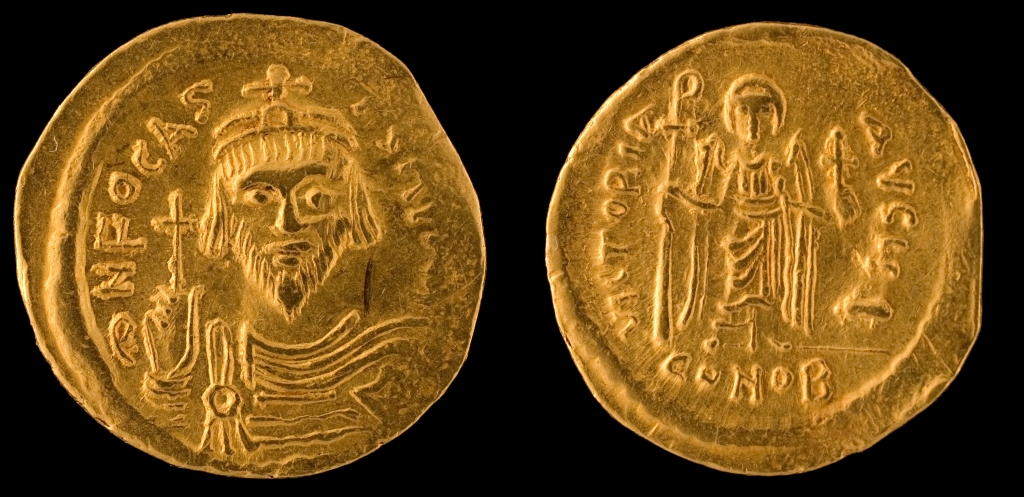
Gold Solidus of Phocas, 4.28 g.
Title
Gold Solidus of Phocas, 4.28 g.
Creator
Phocas
Date
602-610 CE
Description
Obverse: Facing bust of Phocas, wearing paludamentum and crown with cross, holding globus cruciger in right hand; D(OMINVS) N(OSTER) FOCAS PERP(ETVVS) AVG(VSTVS): Our lord Phocas, perpetual Augustus.
Reverse: Standing angel facing, holding staff with Christogram in right hand, globus cruciger in left; VICTORIA AVGV(STI): Victory of the Augustus; in exergue, CONOB: gold of Constantinople.
Style/Period: Byzantine
In 602 CE Phocas, a junior officer of barbarian descent, led his troops in a mutinous revolt against the imperial government and succeeded in taking the throne. He initiated a reign of terror aimed particularly at the aristocracy, and in the ensuing chaos the Persian army advanced on the Balkans and Asia Minor. The situation was saved with the intervention of Heraclius, who deposed Phocas.
The coins of Phocas are unusual because they revive an interest in portraiture, which the engravers of the stylized portraits of most early Byzantine emperors had long ignored. In contrast to the busts of other sixth-century emperors, the portrait of Phocas emphasizes his barbarian heritage. His pointed beard and his straight, shaggy hair give him a distinctly foreign appearance, and he wears a simple crown and a military cloak, the paludamentum, fastened with a fibula or pin on the right shoulder. His beard set a precedent for most later emperors.
The inscription on the reverse abandons the usual legend VICTORIA AVCCC, the abbreviation of the plural Augustorum indicating the joint rule of more than one Augustus (see 91.268, 91.269, 91.270, 91.272). In this period of sole rulers the legend had long been anachronistic, but Phocas' decision to change it to refer to a single Augustus may have been intended to emphasize his determination, in the face of mounting opposition, to rule alone.
-- Timothy S. Riley, LU '92
Bibliography: P. Grierson, Byzantine Coins (London 1982).
Source
Former collection of Ottilia Buerger. Purchased from Frederick Knobloch, February, 1959.
Identifier
91.274
Rights
Wriston Art Center Galleries, Lawrence University, Appleton, WI,wriston-gallery@lawrence.edu,920-832-6890
Subject
Byzantine, Phocas, paludamentum, crown, cross, globus cruciger, angel, staff, Christogram
Files
Citation
Phocas, “Gold Solidus of Phocas, 4.28 g.,” Lawrence University Classics Department & Ottilia Buerger Coin Collections, accessed November 5, 2026, https://thor.lawrence.edu/omeka/buerger/items/show/322.