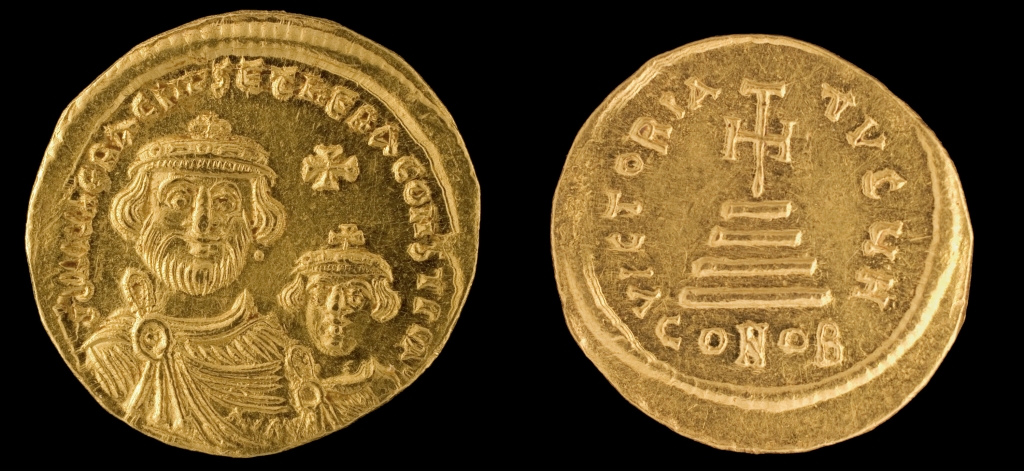
Gold Solidus of Heraclius and Heraclius Constantine, 4.44 g.
Title
Gold Solidus of Heraclius and Heraclius Constantine, 4.44 g.
Creator
Heraclius, Heraclius Constantine
Date
613-625 CE
Description
Obverse: Facing bust of Heraclius with beard on left, facing bust of Heraclius Constantine on right, each wearing chlamys and crown with cross; cross in field between heads; DD (DOMINI abbreviated) NN(NOSTRI abbreviated) HERACLIVS ET HERA(CLIVS) CONST(ANTINVS) P(ER)P(ETVI) AV(GVSTI): Our lords Heraclius and Heraclius Constantine, perpetual Augusti.
Reverse: Cross potent on steps; VICTORIA AVCV(STI) H: Victory of Augustus, officina mark H; in exergue, CONOB: gold of Constantinople.
Style/Period: Byzantine
Heraclius overthrew his hated predecessor, Phocas, in 610 CE. He regained much of the territory that had been lost by his predecessors and ensured stability by re-establishing the practice of adopting an heir who ruled in association with him. His eldest son, Heraclius Constantine, was made Augustus soon after he was born.
The obverse of this solidus of Heraclius proclaims his intention to rule jointly with his son and establishes the conventions of coin portraits for joint rulers. Heraclius as the senior ruler is depicted on the left, with the junior Heraclius Constantine on the right. Differences in scale underscore the differences in age and seniority, as does the fact that Heraclius Constantine has not yet acquired a beard. The chlamys worn by the two figures is civilian garb and in most emperor portraits of the seventh century replaces the armor of earlier emperors. It was a long, embroidered purple cloak, fastened on the right shoulder by a fibula or pin, which in imperial portraits takes the form of a round brooch with three pendants.
The reverse revives the cross on the steps, a type introduced by Tiberius Constantine (see 91.272), understood to represent the cross on the hill of Calvary; it would become the main reverse type of the seventh century.
-- Rebecca K. Browning Wojcik, LU '93
Bibliography: W. Wroth, Catalogue of the Imperial Byzantine Coins in the British Museum (London 1908) 28; P. Grierson, Byzantine Coins (London 1982).
Source
Former collection of Ottilia Buerger. Purchased from Hesperia Art, February 1959.
Identifier
91.275
Rights
Wriston Art Center Galleries, Lawrence University, Appleton, WI,wriston-gallery@lawrence.edu,920-832-6890
Subject
Byzantine, Heraclius, Heraclius Constatine, chlamys, crown, cross, cross potent, steps
Files
Citation
Heraclius, Heraclius Constantine, “Gold Solidus of Heraclius and Heraclius Constantine, 4.44 g.,” Lawrence University Classics Department & Ottilia Buerger Coin Collections, accessed November 5, 2026, https://thor.lawrence.edu/omeka/buerger/items/show/323.