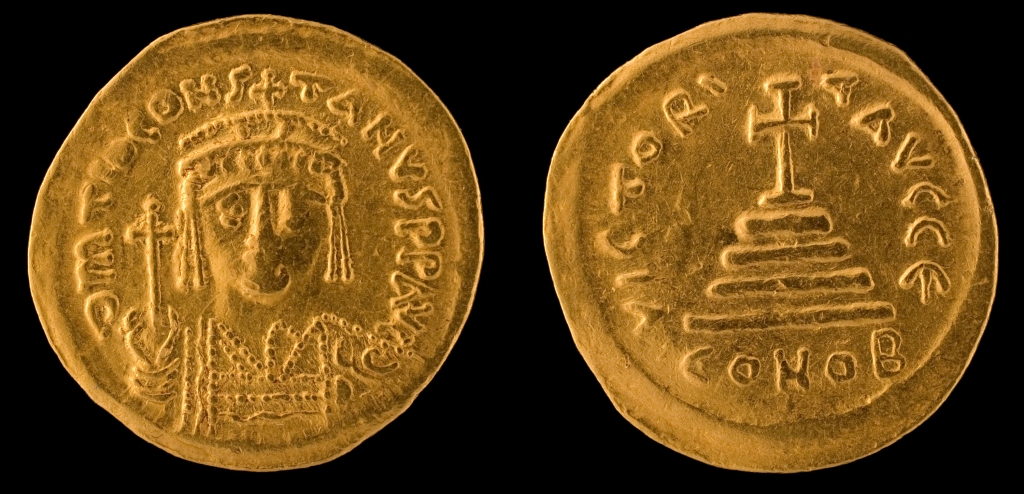
Gold Solidus of Tiberius Constantine, 4.40 g.
Title
Gold Solidus of Tiberius Constantine, 4.40 g.
Creator
Tiberius Constantine
Date
578-582 CE
Description
Obverse: Facing cuirassed bust of Tiberius Constantinius, wearing crown with cross and holding globus cruciger in right hand; at left shoulder, shield depicting attacking horseman; D(OMINVS) N(OSTER) TIB(ERIVS) CONSTAN(TINI)VS P(ER)P(ETVVS) AVC(VSTVS): Our lord Tiberius Constantine, perpetual Augustus.
Reverse: Cross potent on four steps; VICTORIA AVCC (AVGVSTORVM abbreviated) E: Victory of the Augusti, officina mark E; in exergue, CONOB: gold of Constantinople.
Style/Period: Byzantine
Tiberius I was made Caesar by Justin II in 574 CE and renamed Tiberius Constantine. When Justin suffered bouts of insanity, he appointed Tiberius his successor. Tiberius inherited Justin's problems, including the war with the Persians that had begun under Justin, and he was only able to hold the Persians at bay.
For the history of Byzantine coinage, Tiberius plays an important role. He introduced a new reverse type, the cross potent (a cross with a bar at the end of each arm) on four steps, a radical change from the figural types of earlier coinage. The image supposedly came to him in a vision. The cross on the steps is called the cross calvary because it is assumed to refer to the cross on the hill of Calvary. The immediate inspiration for the image may have been the golden cross that was erected on Mount Calvary in the reign of Theodosius II (408-450 CE). Although the type was used only once in sixth-century coinage, it was often used during the seventh and eighth centuries.
-- Timothy S. Riley, LU '92
Bibliography: W. Wroth, Catalogue of the Imperial Byzantine Coins in the British Museum (London 1908); P. Grierson, Byzantine Coins (London 1982).
Source
Former collection of Ottilia Buerger. Purchased from Milton A. Holmes auction, October 18, 1960.
Identifier
91.272
Rights
Wriston Art Center Galleries, Lawrence University, Appleton, WI,wriston-gallery@lawrence.edu,920-832-6890
Subject
Byzantine, Tiberius Constantine, crown, cross, globu cruciger, shield, horseman, horse
Files
Citation
Tiberius Constantine, “Gold Solidus of Tiberius Constantine, 4.40 g.,” Lawrence University Classics Department & Ottilia Buerger Coin Collections, accessed November 5, 2026, https://thor.lawrence.edu/omeka/buerger/items/show/321.