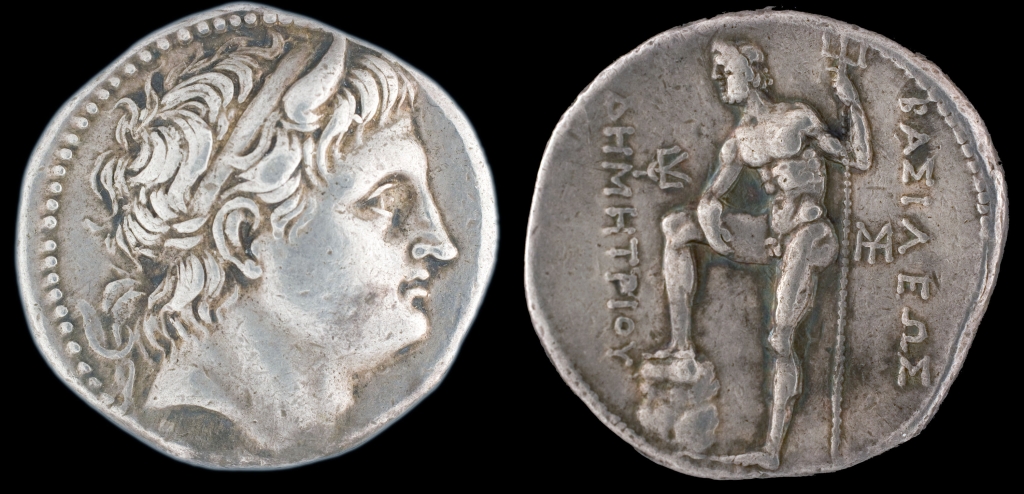
Silver Tetradrachm of Demetrios Poliorketes (Poliorcetes), Macedon (Macedonia), 17.21 g.
Title
Silver Tetradrachm of Demetrios Poliorketes (Poliorcetes), Macedon (Macedonia), 17.21 g.
Creator
Demetrios Poliorketes (Poliorcetes), Macedon (Macedonia)
Date
c. 290 BCE
Description
Obverse: Diademed and horned head of Demetrios facing right
Reverse: Nude Poseidon standing facing left, with right foot on rock, right arm over right thigh, left holding trident; monograms in left and right fields; ΒΑΙΣΙΛΕΩΣ ΔΗΜΗΤΡΙΟΥ: of King Demetrios.
Style/Period: Hellenistic
Demetrios was the son of Antigonos Monophthalmos (the One-eyed), who assumed control of Asia after the death of Alexander the Great. Demetrios earned his nickname Poliorketes (Besieger) from his extensive use of siege machines in an unsuccessful attempt to take the island of Rhodes in 305 BCE After their forces were defeated and Antigonos was killed at the Battle of Ipsos in 301 BCE, Demetrios fled with a large fleet and attempted to establish a base for his power first in Cilicia and then in Greece and Macedonia. Like other successors of Alexander, Demetrios at first issued coins with Alexander's types, although he quickly replaced Alexander's name with his own and added the royal title of basileus that both he and his father had assumed in 306 BCE Soon he established a number of his own types, culminating in the types for these tetradrachms, which were issued in large numbers from c. 290 BCE in preparation for Demetrios' invasion of Asia Minor. The invasion ended disastrously and Demetrios was imprisoned by Seleukos; he died in captivity in 283 BCE.
On the obverse is a youthful, idealized head of Demetrios with the royal diadem and the horns of a bull, the animal sacred to Demetrios' patron deity, Poseidon. With these aspects of divinity Demetrios became the first of Alexander's successors to assimilate elements of Alexander's deified portrait (see 91.046) and the first living ruler to portray himself as a divinity on his coins. The bull's horns were intended to suggest that he stood in the same relationship to Poseidon as Alexander had to Zeus Ammon. The portrait is individualized, but the upward gaze and flowing hair are meant to evoke the image of Alexander.
On the reverse is Demetrios' patron deity, Poseidon, apparently inspired by the original of the Lateran Poseidon, a statue usually attributed to Lysippos, the court sculptor of Alexander. Demetrios' association with Poseidon dated to his naval victory off Cyprus in 306 B.C., after which he considered himself lord of the sea.
-- Kristin J. Brainard Addington, LU '94
Bibliography: O. Mørkholm, Early Hellenistic Coinage from the Accession of Alexander to the Peace of Apamea (336-188 B.C.) (Cambridge 1991) 77-81.
Source
Former collection of Ottilia Buerger. Bought from Münzen und Medaillen, 1971.
Identifier
91.060
Rights
Wriston Art Center Galleries, Lawrence University, Appleton, WI,wriston-gallery@lawrence.edu,920-832-6890
Subject
Hellenistic, diadem, horns, Demetrios, Poseidon, trident, Demetrios Poliorketes, Poliorcetes, Macedon, Macedonia
Files
Citation
Demetrios Poliorketes (Poliorcetes), Macedon (Macedonia), “Silver Tetradrachm of Demetrios Poliorketes (Poliorcetes), Macedon (Macedonia), 17.21 g.,” Lawrence University Classics Department & Ottilia Buerger Coin Collections, accessed November 5, 2026, https://thor.lawrence.edu/omeka/buerger/items/show/216.