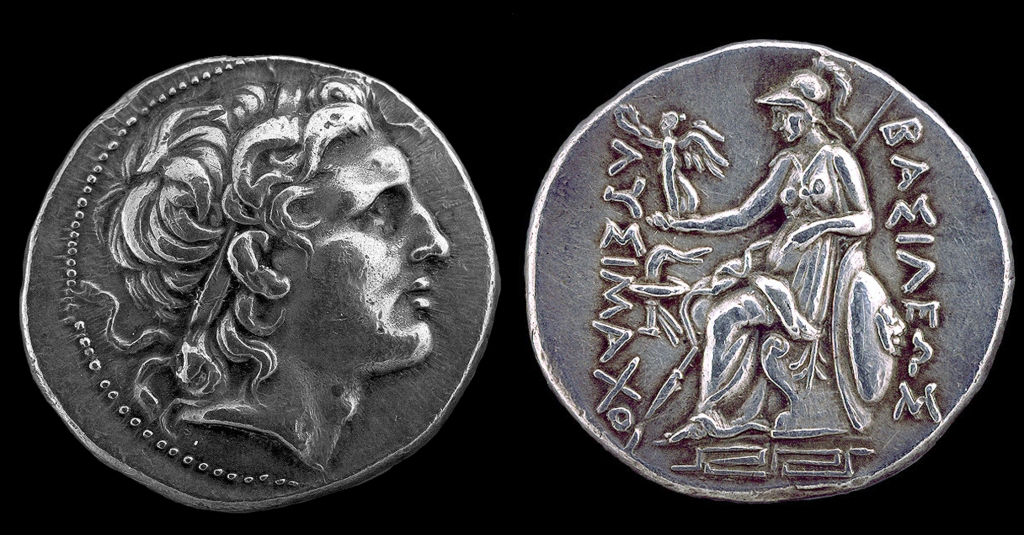
Silver Tetradrachm of Lysimachos (Lysimachus), Thrace, 17.09 g.
Title
Silver Tetradrachm of Lysimachos (Lysimachus), Thrace, 17.09 g.
Creator
Lysimachos (Lysimachus), Thrace
Date
297-281 BCE
Description
Obverse: Head of Alexander facing right, with diadem and Ammon horns.
Reverse: Athena Nikephoros seated facing left with spear and shield, holding Nike in right; in left field, torch; in exergue, maeander; ΒΑΣΙΛΕΩΣ ΛΥΣΙΜΑΧΟΥ: of King Lysimachos.
Style/Period: Hellenistic
Lysimachos was a member of the bodyguard of Alexander the Great. In the division of the empire after Alexander's death, he was entrusted with Thrace and adjoining territory in the Euxine, and in the Battle of Ipsos in 301 BCE he acquired northwestern Asia Minor. Like the other successors of Alexander, he first issued coins with the types used by Alexander, but in 297 BCE he created new types, among them the obverse of this coin, one of the most influential images in Hellenistic coinage.
The head is a portrait of the deified Alexander, with the royal diadem and the ram's horns that identify him as the son of Zeus Ammon. Lysimachos thus portrays Alexander as both his political ancestor and his patron god. The coins were issued at many mints (the maeander on the reverse indicates that this coin was issued at Magnesia-on-Maeander; see 91.082), and their Alexander portrait type with its divine attributes provided the prototype for depictions of divine rulers in later Hellenistic coinage. The coins continued to be issued after the death of Lysimachos and in some areas were as common as posthumous coins of Alexander.
The reverse refers more specifically to Lysimachos. In her right hand, a seated Athena extends her Nike, who crowns the first letter of Lysimachos' name. The gesture is a probable reference to his victory at Ipsos. The lion's head on Athena's shield may also refer to Lysimachos; the forepart of a lion was his personal device. He participated in lion hunts with Alexander and supposedly once killed a lion with his bare hands.
-- Kristin J. Brainard Addington, LU '94
Bibliography: M. Thompson, "The Mints of Lysimachos," Essays in Greek Coinage Presented to Stanley Robinson (Oxford 1968) 163-182; O. Mørkholm, Early Hellenistic Coinage from the Accession of Alexander to the Peace of Apamea (336-188 B.C.) 81.
Source
Former collection of Ottilia Buerger. Purchased from Hesperia Art, 1960.
Identifier
91.046
Rights
Wriston Art Center Galleries, Lawrence University, Appleton, WI,wriston-gallery@lawrence.edu,920-832-6890
Subject
Hellenistic, Alexander, diadem, Zeus Ammon, horns, Athena Nikephoros, Lysimachos, Lysimachus, Thrace
Files
Citation
Lysimachos (Lysimachus), Thrace, “Silver Tetradrachm of Lysimachos (Lysimachus), Thrace, 17.09 g.,” Lawrence University Classics Department & Ottilia Buerger Coin Collections, accessed November 5, 2026, https://thor.lawrence.edu/omeka/buerger/items/show/219.