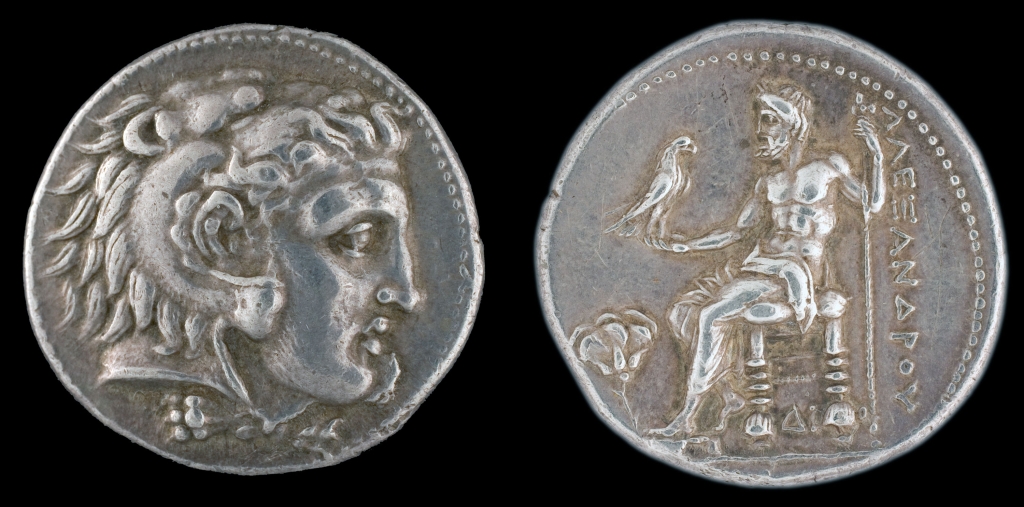
Silver Tetradrachm of Alexander III, Macedon (Macedonia), 17.21 g.
Title
Silver Tetradrachm of Alexander III, Macedon (Macedonia), 17.21 g.
Creator
Alexander III, Macedon (Macedonia)
Date
c. 332-323 BCE
Description
Obverse: Head of Herakles in lionskin cap facing right
Reverse: Zeus enthroned facing left, holding eagle in right hand and scepter in left hand; rose in left field; ΔΙ - Ο beneath throne; ΑΛΕΞΑΝΔΡΟΥ: of Alexander.
Style/Period: Hellenistic
Alexander the Great of Macedonia inherited his father's dream of conquering the Persian empire. Soon after his father's assassination in 336 BCE, Alexander led Greek and Macedonian forces into Asia Minor, sweeping down the coast and liberating its Greek cities from the Persians. He occupied Syria and Phoenicia and was accepted as pharaoh of Egypt. There he founded the important city of Alexandria and visited the oracle of Zeus Ammon, where he was recognized as a son of Zeus. He then turned eastward toward Mesopotamia, where he defeated the main army of the Persians. Finally, he pushed further eastward, beyond the Indus River, where in 327 BCE his exhausted troops forced him to turn back. On the return Alexander began to secure and organize his far-flung empire, but in the summer of 323 BCE he died of fever in Babylonia.
Alexander reformed Macedonian coinage, instituting types that would be circulated throughout his empire long after his death. The most important were the types on his tetradrachms, which soon replaced the Athenian "owls" (see 91.069) as the most widely circulated coins of antiquity. On the obverse is the head of Herakles, reference to his family's claim of descent from the hero. Alexander was particularly devoted to Herakles and in time came to be identified with him. Whether the features of Herakles on the coins were subtly altered to those of Alexander in his lifetime is uncertain, but after his death the image was widely regarded as a portrait of Alexander. His father's use of the head of Zeus on his staters may have inspired Alexander to put a full figure of Zeus on the reverse, but the god acquired particular significance for him after the visit to the oracle. Greeks recognized the figure as their chief god, but to the inhabitants of Persian lands it could also represent their god Baal, also depicted enthroned with an eagle and scepter.
The hundreds of small symbols and letters on the coins of Alexander and his successors are probably control marks of particular issues, apparently a system to safeguard the production of the coins. The marks on this coin indicate that it was struck at Memphis during Alexander's lifetime.
-- Kristen L. Ratwik Lamppa, LU '93
Bibliography: M.J. Price, The Coinage in the Name of Alexander and Philip Arrhidaeus (Zurich and London 1991) 498 no. 397, pl. CXIV.
Source
Former collection of Ottilia Buerger. Bought from Bank Leu, 1971.
Identifier
91.053
Rights
Wriston Art Center Galleries, Lawrence University, Appleton, WI,wriston-gallery@lawrence.edu,920-832-6890
Subject
Hellenistic, Herakles, lion skin cap, Zeus, eagle, scepter, Alexander III, Macedon (Macedonia)
Files
Citation
Alexander III, Macedon (Macedonia), “Silver Tetradrachm of Alexander III, Macedon (Macedonia), 17.21 g.,” Lawrence University Classics Department & Ottilia Buerger Coin Collections, accessed November 5, 2026, https://thor.lawrence.edu/omeka/buerger/items/show/215.