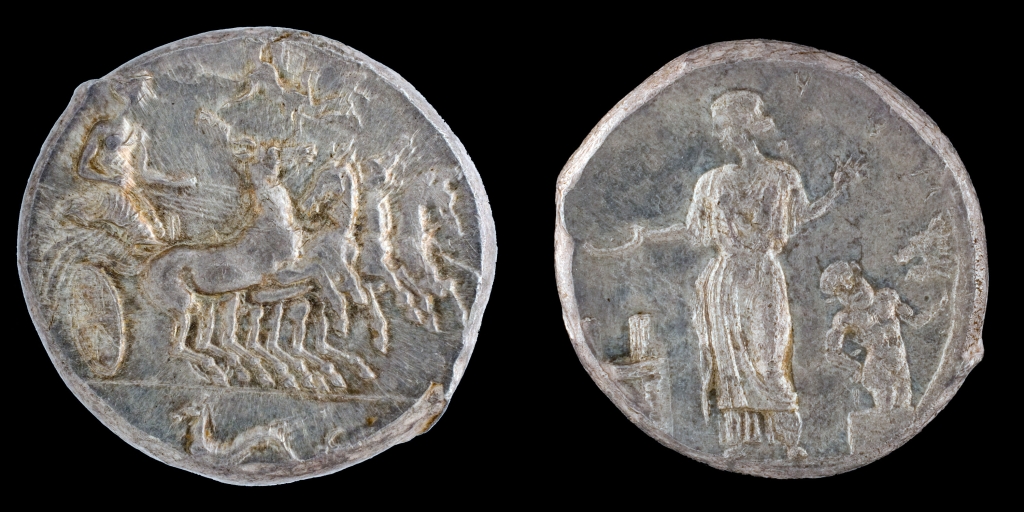
Silver Tetradrachm of Himera, Sicily, Italy, 16.65 g.
Title
Silver Tetradrachm of Himera, Sicily, Italy, 16.65 g.
Creator
Himera, Sicily, Italy
Date
c. 410 BCE
Description
Obverse: Fast quadriga facing right; Nike above bearing wreath and tablet inscribed ΜΑΙ; hippocamp in exergue.
Reverse: The nymph Himera standing facing right, holding a phiale over an altar in right hand; to right a satyr bathing under lion-head fountain spout; [Ι]ΜΕΡ[ΑΙΟΝ] retrograde: of the Himerans.
Style/Period: Greek (ancient)
The colony of Himera on the northern coast of Sicily was founded about 650 BCE by settlers from Zankle, another colony further to the east. It was occupied by Theron, tyrant of Akragas, from c. 482 until 470 BCE, when it came under Syracusan influence. A series of tetradrachms followed, which ended with the Carthaginian destruction of Himera in 409 BCE.
The influence of Syracusan coinage is immediately evident in the obverse of this tetradrachm, which depicts the racing quadriga, its charioteer crowned by Nike, that had by this time become a standard type on Syracusan coins. In particular, the quadriga imitates the exuberant types of the artist Kimon, in the way that the wheels of the quadriga are foreshortened and in the horses' heads tossed in different directions (see 93.007). The three letters on the tablet in Nike's left hand are probably an abbreviated artist's signature; the artist Euainetos put his signature in the same place on tetradrachms of Syracuse in this period. The hippocamp in the exergue, which also appears on Syracusan coins, probably refers to the importance of Himera's sea trade.
The reverse portrays a local subject, the nymph Himera standing at an altar and making a sacrifice, while a satyr bathing under a lion-head spout probably refers to the warm springs near Himera. Himera, in the clinging drapery typical of late fifth-century sculpture, holds a phiale or offering bowl in her right hand and makes a gesture of prayer or sacrifice with the left.
-- Kathleen L. Metzger Newmyer, LU '94
Bibliography: C.M. Kraay, Archaic and Classical Greek Coins (Berkeley and Los Angeles 1976); G. Rizzo, Monete greche della Sicilia (Rome 1946), pl. 21.23.
Source
Former collection of Ottilia Buerger. Bought from Bank Leu, December 9, 1985.
Identifier
91.024
Rights
Wriston Art Center Galleries, Lawrence University, Appleton, WI,wriston-gallery@lawrence.edu,920-832-6890
Subject
Greek, quadriga, Nike, wreath, tablet, hippocamp, nymph, Himera, phiale, altar, satyr, fountain, Himera, Sicily, Italy
Files
Citation
Himera, Sicily, Italy, “Silver Tetradrachm of Himera, Sicily, Italy, 16.65 g.,” Lawrence University Classics Department & Ottilia Buerger Coin Collections, accessed November 5, 2026, https://thor.lawrence.edu/omeka/buerger/items/show/182.