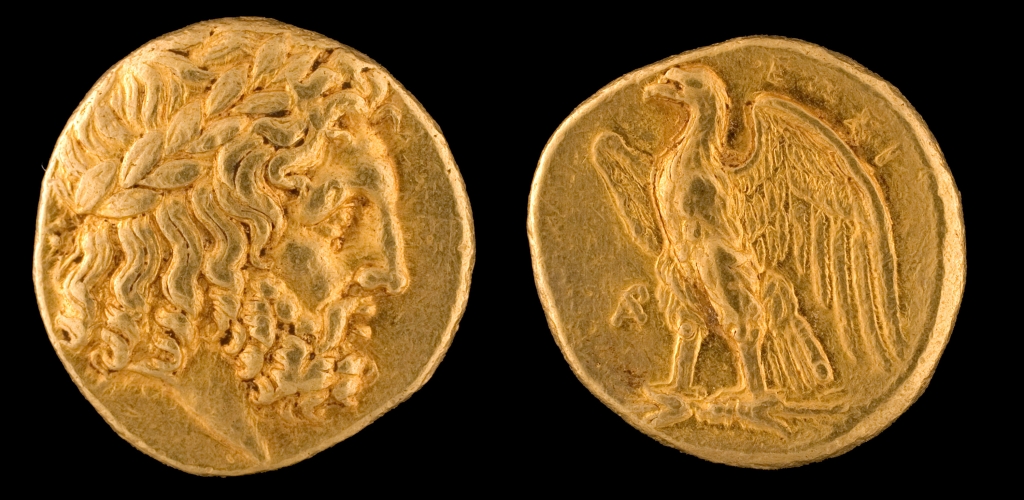
Gold Stater of Tarentum (Taras), Calabria, Italy, 8.57g
Title
Gold Stater of Tarentum (Taras), Calabria, Italy, 8.57g
Creator
Tarentum (Taras), Calabria, Italy
Date
c. 280 BCE
Description
Obverse: Bearded and laureate head of Zeus to right
Reverse: Eagle with spread wings on thunderbolt to left; monogram in left field.
Style/Period: Greek (ancient)
Taras, known as Tarentum to the Romans, was located on a bay opening into what is now called the Gulf of Taranto. It was the only colony of Sparta, and, with the only good port on the southeastern coast of Italy, it became a thriving commercial center known for its luxury.
Taras was often in conflict with its Italian neighbors and it regularly sought help from foreign mercenaries. When threatened by the Romans c. 281 B.C., Taras called in Pyrrhos of Epeiros, who came to Italy the next year with men and elephants. He fought the Romans in several battles but in 275 B.C. withdrew from Taras and went to assist the Greek cities in Sicily against their enemies the Carthaginians; Taras eventually surrendered to Rome. The coins of Taras were briefly influenced by the presence of Pyrrhos. Zeus had an important sanctuary at Dodona in Epeiros, and Zeus was a favorite Epeirot coin type. While Pyrrhos was at Taras the city issued gold staters with a head of Zeus on the obverse and his symbols the eagle and thunderbolt on the reverse. The head was very similar to the head on Epeirot coins, but the Epeirot oak wreath was replaced at Taras by a wreath of laurel.
--Carol L. Lawton
Bibliography: G.C. Brauer, Jr., Taras: its History and Coinage (New Rochelle, NY 1986).
Source
Former collection of Ottilia Buerger. Bought at Bank Leu auction, April 23, 1980.
Identifier
91.005
Rights
Wriston Art Center Galleries, Lawrence University, Appleton, WI,wriston-gallery@lawrence.edu,920-832-6890
Subject
Greek, god, Zeus, eagle, thunderboldt, Tarentum, Taras, Calabria, Italy
Files
Citation
Tarentum (Taras), Calabria, Italy, “Gold Stater of Tarentum (Taras), Calabria, Italy, 8.57g,” Lawrence University Classics Department & Ottilia Buerger Coin Collections, accessed November 5, 2026, https://thor.lawrence.edu/omeka/buerger/items/show/183.