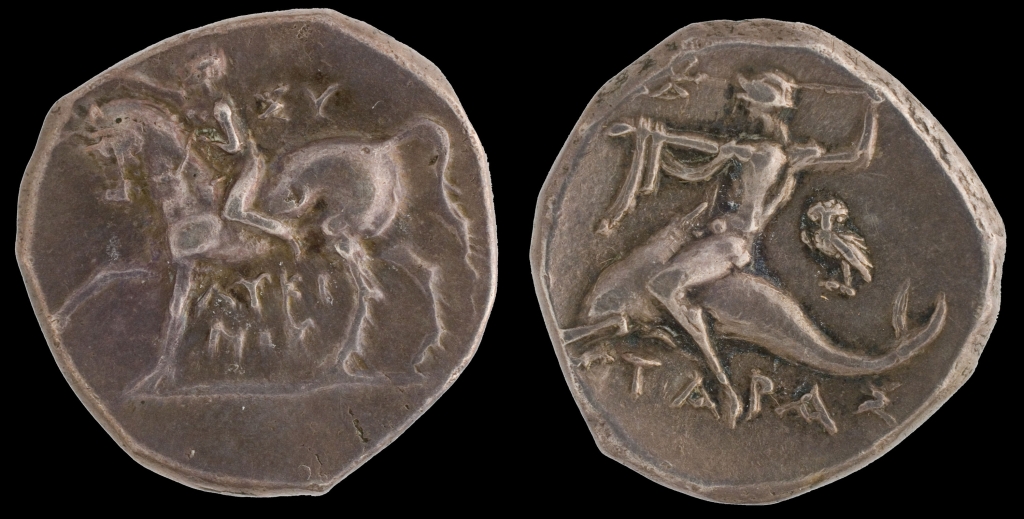
Silver Stater of Tarentum (Taras), Calabria, Italy, 6.29 g
Title
Silver Stater of Tarentum (Taras), Calabria, Italy, 6.29 g
Creator
Tarentum (Taras), Calabria, Italy
Date
272-235 BCE
Description
Obverse: Boy-rider crowning horse to left; above and beneath horse, ΣΥ-ΛΥΚΙ-ΝΟΣ: Sylykinos.
Reverse: Taras or Phalanthos riding dolphin to left and wielding trident in right arm; owl in right field;ΤΑΡΑΣ: Taras.
Style/Period: Greek (ancient)
According to tradition, Taras was founded in 706 B.C. by colonists from Sparta. The story of its foundation is reflected in its most familiar coin type, a figure riding on a dolphin. Some identify the figure as Phalanthos, the leader of the Spartan colonists who was shipwrecked before he reached Taras but saved by a dolphin that carried him ashore (Pausanias, Description of Greece, 10.13.10). Whether Phalanthos was an historical figure is not known; he was worshipped as a hero in Taras. Others identify the figure as Taras, the local hero for whom the city was named, particularly since the figure is usually accompanied by the name Taras. A son of the sea god Poseidon, he too was saved from a shipwreck by a dolphin sent by his father. According to the account of Pausanias, both Phalanthos and Taras, as well as the helpful dolphin, were featured in a fifth-century statuary group set up by the Tarantines in the sanctuary of Apollo at Delphi to commemorate a victory over barbarians from the north.
When the dolphin rider was moved to the reverse of the coins in the late fifth century, he was replaced on the obverse by the famous Tarantine horsemen, who were depicted on the coins for another two hundred years with considerable diversity and inventiveness. The horsemen cannot be specifically identified; they range from boys to youths, from nude to armed, and engage in a wide variety of equestrian activities, perhaps alluding to athletic games held at Taras. The nude rider on this coin crowns his horse, probably in celebration of victory in a contest.
-- Carol L. Lawton
Bibliography: A.J. Evans, "The 'horsemen' of Tarentum," Numismatic Chronicle 1881, 1 ff.; G.C. Brauer, Jr., Taras: its History and Coinage (New Rochelle, NY 1986).
Source
Former collection of Ottilia Buerger. Bought from Edward Gans, Jan., 1959.
Identifier
91.004
Rights
Wriston Art Center Galleries, Lawrence University, Appleton, WI,wriston-gallery@lawrence.edu,920-832-6890
Subject
Greek, boy, rider, horse, Taras, Phalanthos, dolphine, trident, owl, Tarentum, Calabria, Italy
Files
Citation
Tarentum (Taras), Calabria, Italy, “Silver Stater of Tarentum (Taras), Calabria, Italy, 6.29 g,” Lawrence University Classics Department & Ottilia Buerger Coin Collections, accessed November 5, 2026, https://thor.lawrence.edu/omeka/buerger/items/show/181.