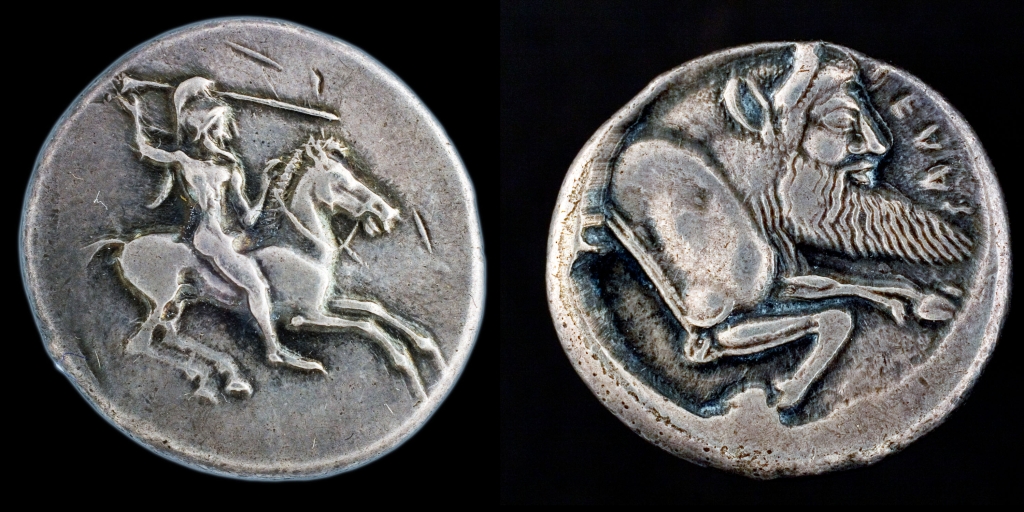
Silver Didrachm of Gela, Sicily, Italy, 8.56 g.
Title
Silver Didrachm of Gela, Sicily, Italy, 8.56 g.
Creator
Gela, Sicily, Italy
Date
c. 490 BCE
Description
Obverse: Helmeted and bearded nude horseman hurling spear with right hand.
Reverse: Forepart of a swimming man-headed bull swimming right; ΓΕΛΑΣ retrograde: Gelas.
Style/Period: Greek (ancient)
According to Thucydides (History 6.4), the colony of Gela was founded in 680 B.C. by Rhodians and Cretans. It was located on a fertile plain near the mouth of the river Gela, for which the city was named. In the late sixth and early fifth centuries the city flourished under the tyrants Hippokrates and Gelon, until Gelon seized Syracuse and moved part of the Geloan population there.
The rider of the obverse probably refers generally to the Geloan aristocracy, which was known for its horse-breeding and equestrian abilities; the city was also famous for its cavalry, which the large number of didrachms produced in this period may have been intended to pay. The type could also refer more specifically to the tyrant who first introduced the type, either Hippokrates, whose name means "strong as a horse" or Gelon, who was a hipparch or cavalry commander under Hippokrates. The nude rider has the sharply emphasized musculature and the combination of nearly frontal torso and profile legs that are characteristic of late Archaic art. The man-faced bull, which is the main coin-type of Gela in the fifth century, is a standard type for the Greek river god Acheloos, but here as elsewhere it probably represents the local river god. Its frontal eye in the profile head and highly patterned beard are also characteristic of Archaic art.
-- Kathleen L. Metzger Newmyer, LU '94
Bibliography: G.K. Jenkins, The Coinage of Gela, 2 vols. (Berlin 1970), 186 no. 47, pl. 3.
Source
Former collection of Ottilia Buerger. Bought from Coin Galleries, February 21, 1962.
Identifier
91.023
Rights
Wriston Art Center Galleries, Lawrence University, Appleton, WI,wriston-gallery@lawrence.edu,920-832-6890
Subject
Greek, helmet, horseman, spear, swimming, man-headed bull, Gela, Sicily, Italy
Files
Citation
Gela, Sicily, Italy, “Silver Didrachm of Gela, Sicily, Italy, 8.56 g.,” Lawrence University Classics Department & Ottilia Buerger Coin Collections, accessed November 5, 2026, https://thor.lawrence.edu/omeka/buerger/items/show/180.