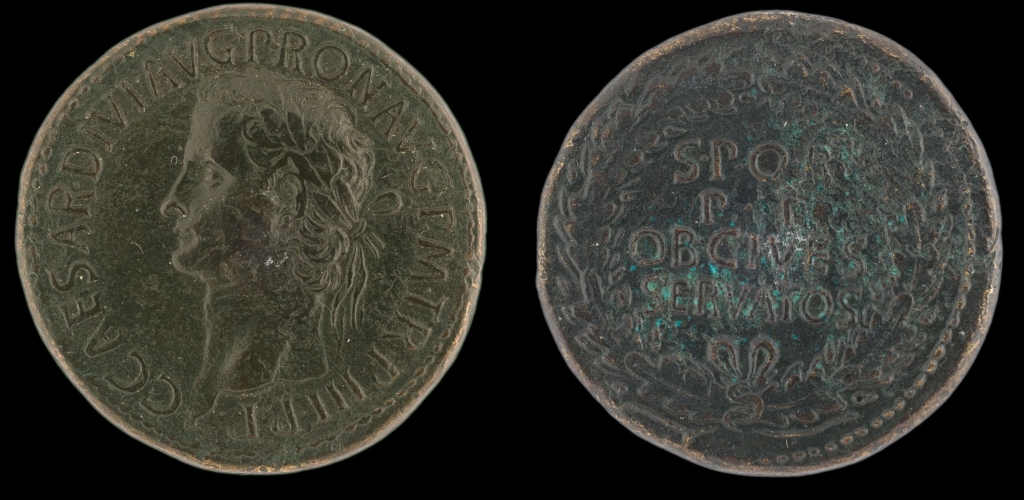
(Copper/bronze/brass) Sestertius of Caligula, 28.87 g.
Title
(Copper/bronze/brass) Sestertius of Caligula, 28.87 g.
Creator
Caligula
Date
39-40 CE
Description
Obverse: Laureate head, C(AIVS) CAESAR DIVI AVG(VSTI) PRON(EPOS) AVG(VSTVS) P(ONTIFEX) M(AXIMVS) TR(IBVNICIA) P(OTESTATE) III P(ATER) P(ATRIAE): Gaius Caesar Augustus, great grandson of Divine Augustus, pontifex maximus, with tribunician power for the third time, father of the country
Reverse: S(ENATVS) P(OPVLVS) Q(VE) R(OMANVS)/ P(ATER) P(ATRIAE)/ OB CIVES/ SERVATOS in four lines, within oak wreath: The Senate and the People of Rome, pater patriae, for having saved the citizens
Style/Period: Early Roman Empire
The obverse of this coin depicts the head of Caligula, third emperor of Rome, with a laurel wreath on his head. The inscription identifies him as the great-grandson of Divine Augustus. While Caligula was not the biological great-grandson of Augustus, his father, Germanicus, was adopted by Tiberius in 4 CE. Tiberius himself had been adopted by Augustus, after Augustus married Livia Drusilla, thus making Caligula the great-grandson of Augustus. In his portrait on the obverse, Caligula is depicted in the typical idealized Julio-Claudian style started by Augustus. However, Caligula was very young when he was emperor (his mid-late twenties), so it is possible this reflected more of his actual appearance, especially as it features the very broad forehead mentioned by Suetonios in his life of Caligula (50).
The reverse of the coin has an inscription with an oak wreath around it. This oak wreath can be identified as the corona civica, or civic crown. The corona civica was granted by the Senate to citizens who had saved the lives of other citizens in battle. It was awarded to Augustus in 27 BCE. The inscription indicates that Augustus received this honor “for having saved the citizens,” that is by putting an end to a period of turbulence in Roman history and bringing peace to the new empire. This inscription fits also well with the obverse of the coin, and it is clear that Caligula was attempting to both honor Augustus and make his connection to him clear.
-- Anna Vogel, LU `18
Bibliography: S. Hornblower and A. Spawforth, eds., The Oxford Classical Dictionary (Oxford 1996), s.v. Augustus, Gaius (1), Germanicus, Tiberius; J. M. Jones, A Dictionary of Ancient Roman Coins (London 1990), s.v. laurel, oak; D. Kleiner, Roman Sculpture (New Haven 1992), 126-127; C.H.V. Sutherland and R.A.G. Carson, The Roman Imperial Coinage, Vol. 1 (London 1984), 110-111.
Source
Former collection of Ottilia Buerger. Purchased from Coin Galleries, March 11, 1960.
Identifier
91.126
Rights
Wriston Art Center Galleries, Lawrence University, Appleton, WI,wriston-gallery@lawrence.edu,920-832-6890
''
Files
Citation
Caligula, “(Copper/bronze/brass) Sestertius of Caligula, 28.87 g.,” Lawrence University Classics Department & Ottilia Buerger Coin Collections, accessed November 5, 2026, https://thor.lawrence.edu/omeka/buerger/items/show/569.