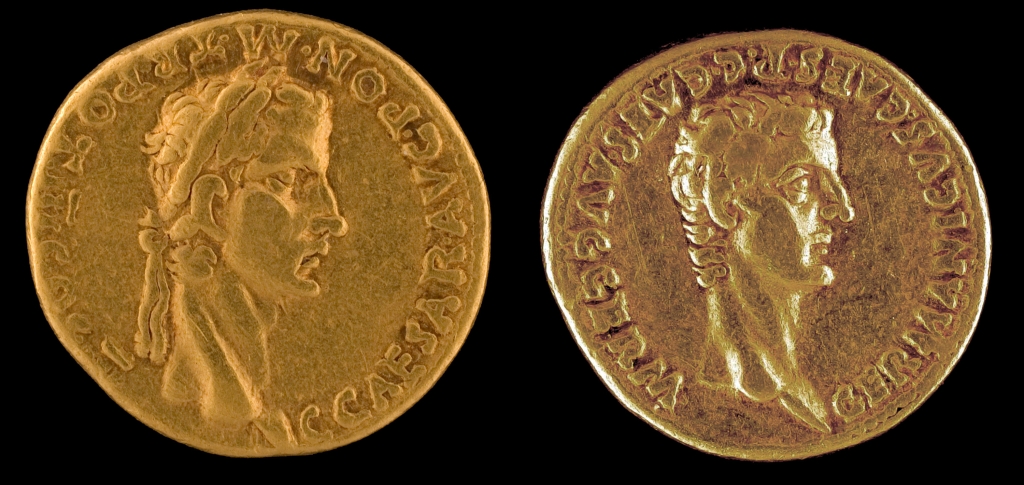
Aureus of Caligula, 7.64 g.
Title
Aureus of Caligula, 7.64 g.
Creator
Caligula
Date
40 CE
Description
Obverse: Laureate head of Caligula. C(AIVS) CAESAR AVG(VSTVS) PON(TIFEX) M(AXIMVS) TR(IBVNICIA) POT(ESTATE) III CO(N)S(VL) III: Gaius Caesar Augustus, pontifex maximus, with tribunician power for the third time, consul for the third time
Reverse: Bare head of Germanicus. GERMANICVS CAES(AR) P(ATER) C(AIVS) CAES(AR) AVG(VSTVS) GERM(ANICVS): Germanicus Caesar, father of Gaius Caesar Augustus Germanicus
Style/Period: Early Roman Empire
The obverse of this coin depicts Caligula (Gaius), the third emperor of Rome, who came into power upon Tiberius’s death. He has a laurel wreath on his head, a symbol of victory often used on the obverse of coins during the Roman Empire. As the inscription indicates, Caligula was given the title pontifex maximus as well as tribunician power and the consulship during his reign. He first took the consulship in 37 CE, which allows this coin to be dated to 40 CE. In the year 40 CE, he served as sole consul. Caligula’s portrait generally reflects the idealized style typical of the Julio-Claudians, but with the sunken eyes, “broad and forbidding forehead,” and perhaps a hint of the baldness that Suetonius mentions (Caligula, 50).
The reverse of the coin depicts Caligula’s father, Germanicus Caesar, with a bare head. Germanicus was adopted by his paternal uncle, the emperor Tiberius. During Tiberius’s reign, he led campaigns in Germany and elsewhere. It was while on the Rhine with Germanicus that Gaius earned the nickname “Caligula” meaning “little boot.” Germanicus’s portrait is also in the typical Julio-Claudian style. Caligula was still relatively young while he served as emperor, indicating that his portrait may be more truthful. However, Germanicus’s portrait is very similar to Caligula’s, with only some small indications of age, showing the idealization present on this coin.
-- Anna Vogel, LU `18
Bibliography: S. Hornblower and A. Spawforth, eds., The Oxford Classical Dictionary (Oxford 1996), s.v. Gaius (1); J. M. Jones, A Dictionary of Ancient Roman Coins (London 1990), s.v. consul, laurel; D. Kleiner, Roman Sculpture (New Haven 1992), 126-127; C.H.V. Sutherland and R.A.G. Carson, The Roman Imperial Coinage, Vol. 1 (London 1984), 108-109.
Source
Former collection of Ottilia Buerger. Purchased from Abner Kreisberg, April 1, 1960.
Identifier
91.123
Rights
Wriston Art Center Galleries, Lawrence University, Appleton, WI,wriston-gallery@lawrence.edu,920-832-6890
''
Files
Citation
Caligula, “Aureus of Caligula, 7.64 g.,” Lawrence University Classics Department & Ottilia Buerger Coin Collections, accessed November 5, 2026, https://thor.lawrence.edu/omeka/buerger/items/show/568.