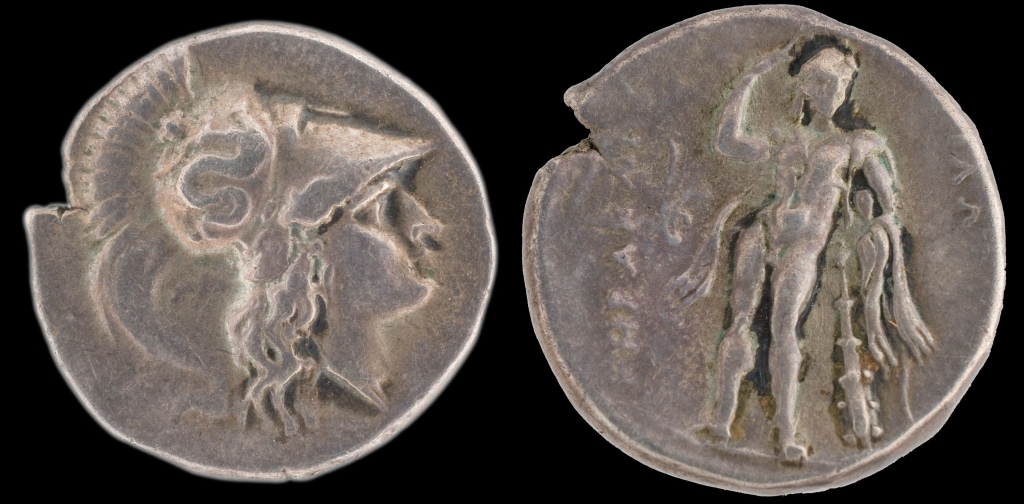
Silver Didrachm of Herakleia, 6.7 g.
Title
Silver Didrachm of Herakleia, 6.7 g.
Creator
Herakleia (Heraclea), Lucania, Italy
Date
c. 332-281 BCE
Description
Obverse: Head of Athena to right, wearing Corinthian helmet with Scylla.
Reverse: Herakles leaning on club with lionskin draped over left arm, crowning himself with right hand. ΗΡΑΚΛΗ[ΙΩΝ]: of the Herakleians.
Style/Period: Greek (ancient)
The ancient city of Herakleia was located in Lucania in southern Italy. It replaced the Ionian city of Siris, a once prosperous city whose origins are unclear. The cities Thurii and Taras, colonies of Athens and Sparta respectively, sought to claim the land that the people of Siris inhabited. The dispute was resolved with the founding of Herakleia in 433/2 about two miles from the site of Siris, with Taras exercising the most control over the city. The geographer Strabo (vi.14) recorded that the people of Siris joined the new colony.
The images on the coins of Herakleia were influenced by the coinage of their founding cities. Athena first appears on Herakleian coinage with the production of Herakleia’s first didrachms in 420 BCE. The image probably comes from the Athenian colony Thurii, whose coins depicted the goddess. On this coin, as on contemporary coins of Thurii, Athena is shown wearing a Corinthian helmet adorned with the image of Scylla, the six-headed monster featured in Homer’s Odyssey; here Scylla may be an allusion to the sea goddess Athena Skyletria, who was worshipped at Herakleia. The reverse of the coin depicts Herakles, for whom the city was named and who is also depicted on contemporary coins of Taras.
-- Kali Steinberg, LU '17
Bibliography: B.V. Head, Historia Numorum. A Manual of Greek Numismatics (Oxford 1911; reprint Chicago 1967) 71-73, 87; E. Work, The Earlier Staters of Heraclea Lucaniae (New York 1940); C. M. Kraay, Archaic and Classical Greek Coins (Berkeley and Los Angeles 1976) 185-186.
Source
Former collection of Ottilia Buerger. Ex Frederick Knobloch collection. Purchased from Coin Galleries, January 21, 1971.
Identifier
91.006
Rights
Wriston Art Center Galleries, Lawrence University, Appleton, WI,wriston-gallery@lawrence.edu,920-832-6890
''
Files
Citation
Herakleia (Heraclea), Lucania, Italy, “Silver Didrachm of Herakleia, 6.7 g.,” Lawrence University Classics Department & Ottilia Buerger Coin Collections, accessed November 5, 2026, https://thor.lawrence.edu/omeka/buerger/items/show/563.