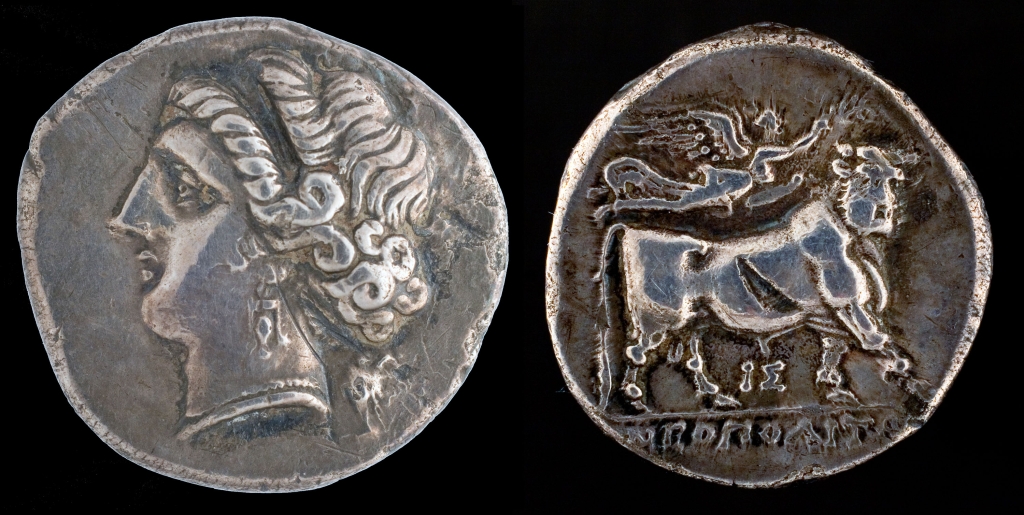
Silver Didrachm of Neapolis, 7.11 g.
Title
Silver Didrachm of Neapolis, 7.11 g.
Creator
Neapolis, Campania, Italy
Date
300-241 BCE
Description
Obverse: Head of Siren Parthenope to left, with headband and earring.
Reverse: Acheloös depicted as man-headed bull to right, head turned toward viewer, crowned by Nike flying overhead; beneath Acheloös, ΙΣ; in exergue, ΝΗΟΠΟΛΙΤΑΣ: of Neapolis.
Style/Period: Hellenistic
Neapolis was a Greek colony on the southwestern coast of the Italian peninsula.
This coin bears an image of the Siren Parthenope on its obverse and the river god Acheloös on its reverse. The Siren Parthenope was understood to have washed up on the shore of Neapolis (originally named Parthenope in her honor), having committed suicide after failing to entice Odysseus and his crew (Strabo 6.1.1). The intricate detail of her curls closely resembles the hair of the famous heads of Arethusa on the coins of Syracuse.
The man-headed bull on the reverse is the father of sirens, the river god Acheloös, who was introduced to Neapolitan coinage around 460. Here he is depicted as a full figure, whereas earlier coins of Neapolis depicted merely his forepart. The imagery of Nike crowning Acheloös suggests that the coin refers to athletic events held in honor of either Acheloös or Parthenope (Strabo 5.4.7). The letters beneath Acheloös begin to appear in the fourth century and are apparently part of a system of control that became necessary with the increased production of coins once Neapolis became the principal mint of Campania.
-- Elliot Mackin, LU '17
Bibliography: B. V. Head, Historia Numorum; A manual of Greek Numismatics (Oxford 1911; reprint Chicago 1967) 38-40; C. M. Kraay, Archaic and Classical Greek Coins ( Berkeley and Los Angeles 1976) 200-201; I. Carradice and M. Price, Coinage in the Greek World (London 1988) 70-71.
Source
Former collection of Ottilia Buerger. Purchased from Edward Gans, January 1959
Identifier
91.002
Rights
Wriston Art Center Galleries, Lawrence University, Appleton, WI,wriston-gallery@lawrence.edu,920-832-6890
''
Files
Citation
Neapolis, Campania, Italy, “Silver Didrachm of Neapolis, 7.11 g.,” Lawrence University Classics Department & Ottilia Buerger Coin Collections, accessed November 5, 2026, https://thor.lawrence.edu/omeka/buerger/items/show/562.