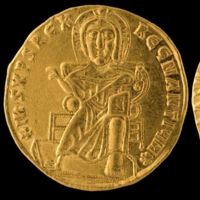
Gold Solidus of Basil I and Constantine, 4.34 g.
Title
Gold Solidus of Basil I and Constantine, 4.34 g.
Creator
Basil I, Constantine
Date
867-879 CE
Description
Obverse: Christ with cross-nimbus behind head, seated on lyre-backed throne, right hand raised in blessing, left holding book; IhS(VS) XP(ISTO)S REX REGNANTIVM: Jesus Christ, King of those who rule.
Reverse: Facing busts of Basil on left, wearing loros and crown with cross, and Constantine on right, wearing chlamys and crown with cross, both holding patriarchal cross between them; BASILIOS ET CONSTANT(INVS) AVGG (AVGVSTI abbreviated) b(ASILEIS): Basil and Constantine, Augusti, kings.
Style/Period: Byzantine
Basil I, a peasant fortune hunter from Macedonia who rose from the position of groom in the imperial stables to co-emperor under the patronage of Michael III, murdered his mentor in 867 CE and founded the Macedonian dynasty. Basil was an effective ruler; his armies were successful against the Arabs, his diplomacy kept the Bulgars at bay, and late in his lifetime he began a revision of the great legal text, the Codex Justinianus.
Iconoclasm, the official condemnation of the veneration of icons, was reversed in 843 CE and soon afterward Michael III re-introduced the bust of Christ on his coins. Basil also introduced a new type, Christ enthroned, one of the few images on Byzantine coins that can probably be traced to a work of art in another medium, the mosaic over the imperial doorway of the Church of Hagia Sophia in Constantinople. The type endured for nearly a century, and from this point onward Christ, the Virgin, or a saint would become standard types for the obverses of Byzantine coins.
In order to secure his dynasty, Basil made his sons co-emperors. The reverse depicts Basil and his eldest and favorite son, Constantine, according to the usual conventions of imperial portraits, with Basil identified as the senior ruler by his scale, position on the left, and the more ornate garment, the loros. Constantine died prematurely in 879 CE and Basil fell into a deep depression and died in a hunting accident in 886 CE.
-- Eric N. Jurgens, LU '93
Bibliography: W. Wroth, Catalogue of the Imperial Byzantine Coins in the British Museum (London 1908) 436.2; P. Grierson, Byzantine Coins (London 1982).
Source
Former collection of Ottilia Buerger. Purchased from Edward Gans, February 1959.
Identifier
91.286
Rights
Wriston Art Center Galleries, Lawrence University, Appleton, WI,wriston-gallery@lawrence.edu,920-832-6890
Subject
Byantine, Christ, cross-nimbus, thrown, book, Basil, loros, crown, cross, Consantine, chlamys, Basil I
Files
Citation
Basil I, Constantine, “Gold Solidus of Basil I and Constantine, 4.34 g.,” Lawrence University Classics Department & Ottilia Buerger Coin Collections, accessed November 5, 2026, https://thor.lawrence.edu/omeka/buerger/items/show/333.