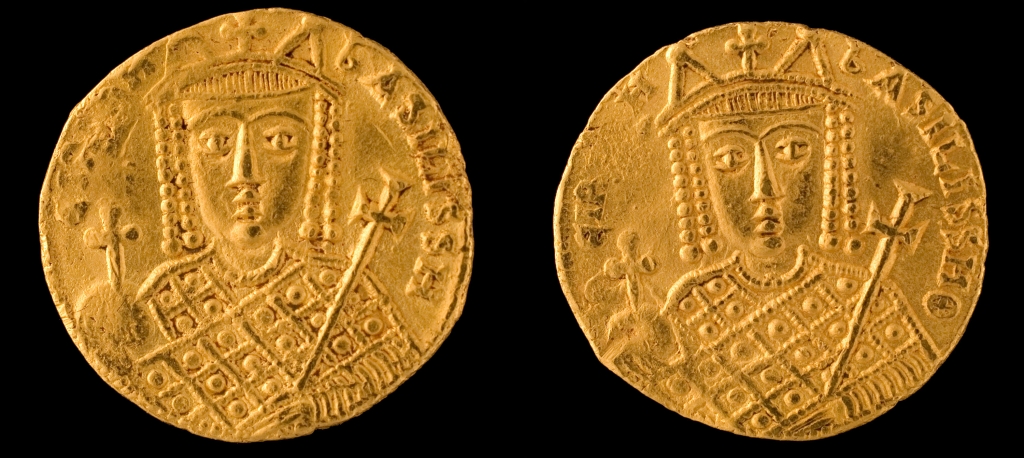
Gold Solidus of Irene, 4.37 g.
Title
Gold Solidus of Irene, 4.37 g.
Creator
Irene
Date
797-802 CE
Description
Obverse: Facing bust of Irene, wearing loros and crown with cross and holding cross scepter in left hand and globus cruciger in right; EIRINH bASILISSH: Queen Eirene.
Reverse: Facing bust of Irene, wearing loros and crown with cross and holding cross scepter in left hand and globus cruciger in right; EIRINH bASILISSH: Queen Eirene.
Style/Period: Byzantine
When Leo IV died in 780 CE, his son, Constantine VI, was made emperor, but since he was only ten years old the empress Irene was made co-emperor. As Constantine grew older, more independent, and reckless, he and his mother struggled for power, and Irene finally had him blinded and deposed. She then became the first Byzantine empress to rule in her own right. She was deposed by Nicephorus I and sent into exile.
Irene was diplomatically and fiscally inept, but she made her mark by rejecting iconoclasm, the official condemnation of the cult of icons, for which she was eventually made a saint of the Orthodox Church. Her reform was short-lived, however, for iconoclasm was reinstated after her deposition. Although in her brief reign religious images were once again permitted, she did not attempt to put them on her coins. Since she could not claim dynastic connections to the emperor she had deposed, she put her own portrait on both the obverse and reverse of her coins. She wears the full imperial dress, including the loros and the characteristic crown of empresses, which has pyramidal spikes and very long prependulia or ornamental chains.
-- Rebecca K. Browning Wojcik, LU '93
Bibliography: P. Grierson, Byzantine Coins (London 1982).
Source
Former collection of Ottilia Buerger. Purchased from Numismatic Fine Arts, 3/1/1979.
Identifier
91.283
Rights
Wriston Art Center Galleries, Lawrence University, Appleton, WI,wriston-gallery@lawrence.edu,920-832-6890
Subject
Byzantine, Irene, loros, crown, cross, cross scepter, globus cruciger
Files
Citation
Irene, “Gold Solidus of Irene, 4.37 g.,” Lawrence University Classics Department & Ottilia Buerger Coin Collections, accessed November 5, 2026, https://thor.lawrence.edu/omeka/buerger/items/show/330.