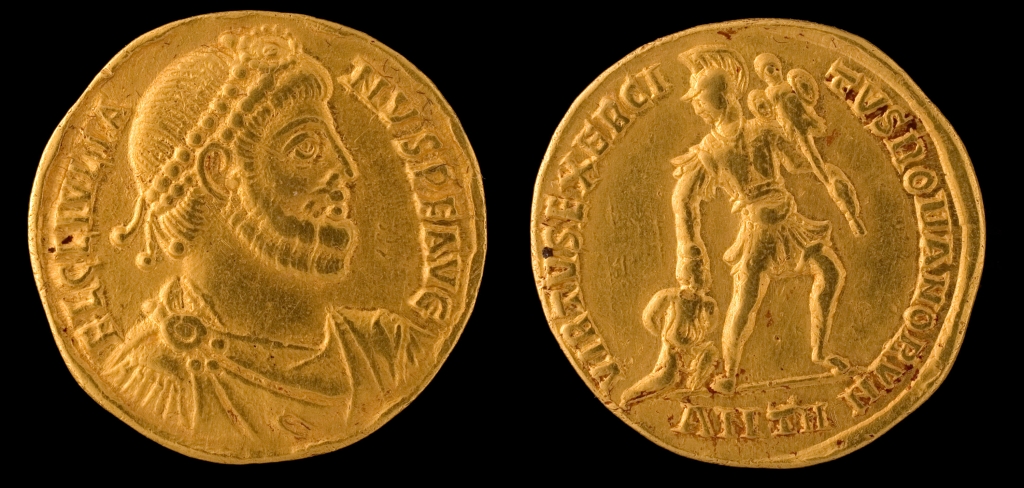
Gold Solidus of Julian II, 3.97 g.
Title
Gold Solidus of Julian II, 3.97 g.
Creator
Julian II
Date
362 CE
Description
Obverse: Diademed, draped, and cuirassed bust of Julian II facing right; FL(AVIVS) CL(AVDIVS) IVLIANVS P(IVS) F(ELIX) AVG(VSTVS): Flavius Claudius Julianus, pious, fortunate Augustus.
Reverse: Soldier, helmeted, standing facing right, head to left, holding trophy in left hand, dragging captive with right; VIRTVS EXERCITVS ROMANORVM: the valour of the Roman army; in exergue, ANTH: Antioch.
Style/Period: Roman Empire
Flavius Claudius Julianus, known to history as Julian the Apostate, was a nephew of Constantine, born in the imperial capital of Constantinople in 332 CE. He and his brother, Gallus, were the only male members of the side of Constantine's family descended from his father's first wife, Theodora, rather than from Constantine's mother, Helena, to survive the massacre of 337 CE, an apparent attempt to wipe out that side of the family. He spent his early years studying philosophy in Asia Minor, where he first became interested in the worship of the old pagan gods. He was made Caesar by the emperor Constantius II in 355 CE and posted to Gaul, where he was successful in dealing with the Germans. His popularity with his troops resulted in his proclamation as emperor in 360 CE. He was spared a war with the emperor by Constantius' death in 361 CE. He openly renounced Christianity, which earned him the name Apostate, and tried unsuccessfully to restore paganism. He was killed in battle in 363 CE.
The portraits of Julian are striking in that he rejected the beardless portrait tradition that had begun with Constantine, probably because of its association with Christianity, and wore instead the beard of earlier pagan emperors. The reverse also reverts to earlier types and even to the more naturalistic, Classical style that was used to portray them.
-- Jonathan D. Greene, LU '93
Bibliography: J.P.C. Kent, The Roman Imperial Coinage VIII: The Family of Constantine A.D. 337-364 (London 1981) Antioch 203.
Source
Former collection of Ottilia Buerger. Purchased from Abner Kreisberg, April 11, 1960.
Identifier
91.249
Rights
Wriston Art Center Galleries, Lawrence University, Appleton, WI,wriston-gallery@lawrence.edu,920-832-6890
Subject
Roman, diadem, curiass, Julian II, soldier, helmet, trophy, captive
Files
Citation
Julian II, “Gold Solidus of Julian II, 3.97 g.,” Lawrence University Classics Department & Ottilia Buerger Coin Collections, accessed November 5, 2026, https://thor.lawrence.edu/omeka/buerger/items/show/317.