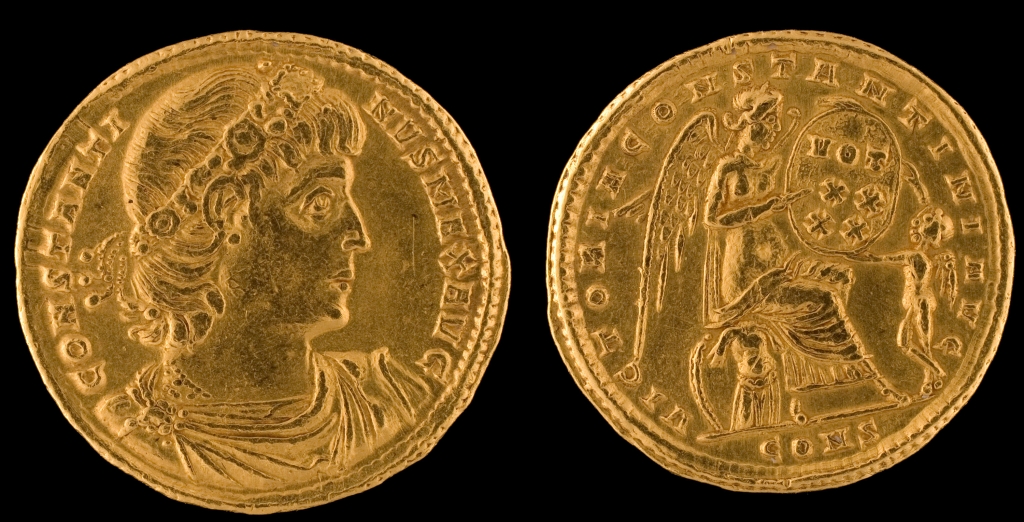
Gold Solidus of Constantine I, 4.42 g.
Title
Gold Solidus of Constantine I, 4.42 g.
Creator
Constantine I
Date
336-337 CE
Description
Obverse: Draped and cuirassed bust of Constantine facing right, wearing rosette diadem; CONSTANTINVS MAX(IMVS) AVG(VSTVS): Constantine the Great Augustus.
Reverse: Victoria seated on cuirass facing right, inscribing shield held by winged genius VOT(A)/XX/XX: vows for forty years of rule; VICTORIA CONSTANTINI AVG(VSTI): Victory of Constantine Augustus; in exergue, CONS: Constantinople.
Style/Period: Roman Empire
Constantine was the son of Constantius, an army officer who became Caesar and one of the rulers of the tetrarchy in 293 CE (see 91.246). When Constantius died in 306 CE, the army proclaimed Constantine emperor, but it was not until the complete dissolution of the tetrarchy and his defeat of several contenders to the throne that Constantine finally emerged as sole Augustus in 324 CE. The true nature of his religious beliefs is still debated, but Constantine was a patron and defender of Christianity, and in his reign the last specifically pagan types on coins die out.
In 309-310 CE, in an effort to stabilize the badly devalued currency of the time, Constantine began issuing a new, somewhat lighter gold coin, the solidus, which was to become the standard gold coin until the tenth century CE. The new capital at Byzantium, which Constantine dedicated and renamed Constantinople, now became a major mint of gold coinage. The mint mark CONS indicates that this solidus was issued there.
Constantine's portrait type constitutes a clear break from the tough soldier types of the tetrarchy. His clean-shaven face and hair combed forward in separate locks over his forehead recall those aspects of the portraits of Trajan (see 91.158). At the same time the upward gaze recalls the coin portraits of Alexander the Great, which served as prototypes for the divine ruler portraiture of much of the Hellenistic age (see 91.046). The diadem, of which this is the most elaborate type, was adopted by Constantine and the members of his house as a new symbol of sovereignty.
The reverse of this coin, struck in 336-337 CE for Constantine's tricennalia or thirtieth anniversary of his acclamation as emperor, records vota or prayers for ten more years of rule; the four X's that Victoria inscribes on the shield refer to a total of forty years. Constantine, however, died the year the vows were undertaken.
-- Benjamin Hayes, LU '93
Bibliography: P.M. Bruun, The Roman Imperial Coinage 7: Constantine and Licinius AD 313- 337 (London 1966) 108.
Source
Former collection of Ottilia Buerger. Purchased from Münzen und Medaillen, 1981.
Identifier
91.240
Rights
Wriston Art Center Galleries, Lawrence University, Appleton, WI,wriston-gallery@lawrence.edu,920-832-6890
Subject
Roman, Empire, Constantine, diadem, Victoria, cuirass, sheild, winged genius
Files
Citation
Constantine I, “Gold Solidus of Constantine I, 4.42 g.,” Lawrence University Classics Department & Ottilia Buerger Coin Collections, accessed November 5, 2026, https://thor.lawrence.edu/omeka/buerger/items/show/316.