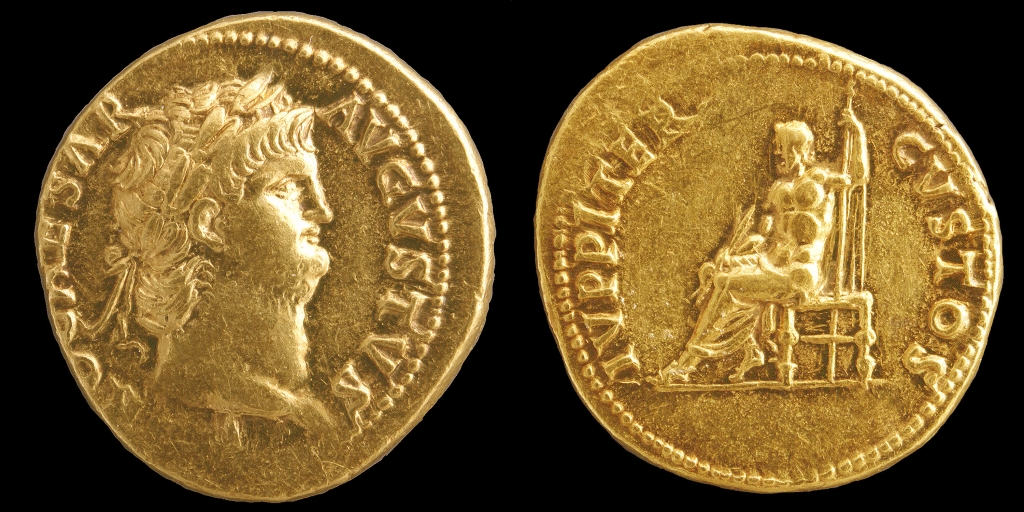
Gold Aureus of Nero, 7.31 g.
Title
Gold Aureus of Nero, 7.31 g.
Creator
Nero
Date
64-65 CE
Description
Obverse: Laureate head of Nero facing right; NERO CAESAR AVGVSTVS: Nero Caesar Augustus.
Reverse: Jupiter seated facing left, holding thunderbolt in right and scepter in left; IVPPITER CVSTOS: Jupiter the Guardian.
Style/Period: Roman Empire
By 65 CE the cruelty and extravagance for which Nero became notorious, including the murder of his mother, wife, step-brother, and tutor, had made him increasingly hated, and a conspiracy named for its leader, Piso, was formed to depose him. Nero's discovery of the plot resulted in a murderous purge. This coin is usually seen as commemorating the failure of the conspiracy, its reverse depicting Jupiter, the "guardian" of Nero. Nero is reported to have dedicated the dagger that was to have killed him to Jupiter Vindex (Avenger) in the Temple of Jupiter on the Capitol. Although the conspiracy failed, revolts occurred in various parts of the empire, and in 68 CE Nero was forced to commit suicide.
The head on the obverse depicts his most well-known and distinctive portrait type, in which he has abandoned the Julio-Claudian features of his youth (see 91.135) for an apparently more realistic type that does nothing to disguise his gross appearance, his facial structure all but disappearing under layers of fat. His distinctive hair rises in a wreath of waves from his forehead and grows long at the nape of his neck. He also has sideburns and a slight beard.
In 64 CE a great fire destroyed much of Rome. The cost of rebuilding was enormous and resulted in a reform of the monetary system. The weight of the aureus was reduced from 1/42 to 1/45 of a Roman pound (that is, from c. 7.70-7.85 g. to c. 7.25-7.40 g.). The weight of this aureus indicates that it was issued after the reform.
--Shannon Gaylord Bakich-Grasser, LU '92
Bibliography: C.H.V. Sutherland, The Roman Imperial Coinage I: from 31 BC to AD 69, rev. ed. (London 1984) 52.
Source
Former collection of Ottilia Buerger. Bought from Coin Galleries, February 27, 1959.
Identifier
91.134
Rights
Wriston Art Center Galleries, Lawrence University, Appleton, WI,wriston-gallery@lawrence.edu,920-832-6890
Subject
Roman, Empire, Nero, Jupiter, thunderbolt, scepter
Files
Citation
Nero, “Gold Aureus of Nero, 7.31 g.,” Lawrence University Classics Department & Ottilia Buerger Coin Collections, accessed November 5, 2026, https://thor.lawrence.edu/omeka/buerger/items/show/260.