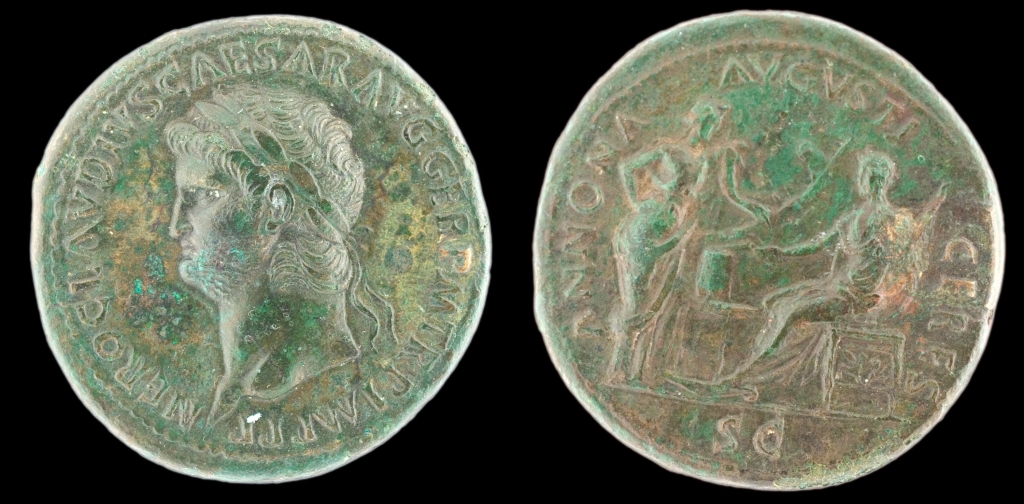
(Copper/bronze/brass) Sestertius of Nero, 25.35 g.
Title
(Copper/bronze/brass) Sestertius of Nero, 25.35 g.
Creator
Nero
Date
64-66 CE
Description
Obverse: Laureate head of Nero facing left; NERO CLAVDIVS CAESAR AVG(VSTVS) GER(MANICVS) P(ONTIFEX) M(AXIMVS) TR(IBVNICIA) P(OTESTATE) IMP(ERATOR) P(ATER) P(ATRIAE): Nero Claudius Caesar Augustus Germanicus, pontifex maximus, with tribunician power, imperator, father of the country.
Reverse: On right, veiled and draped Ceres seated left, holding grain in right and torch in left; on left, draped Annona standing right, right resting on hip, left holding cornucopia; between them, modius on garlanded altar; behind, ship's stern; ANNONA AVGVSTI CERES: Annona and Ceres of the Augustus; in exergue, S(ENATVS) C(ONSVLTO): by decree of the Senate.
Style/Period: Roman Empire
By Nero's time the city of Rome had long ceased to be self-sufficient in its food supplies, especially grain, which had to be imported from all over the empire. Nero took great pains on his coins to refer to the adequacy of the grain supply in his reign. His sestertius depicting his improvements in the Port of Ostia (see 91.141), the main point of entry for the imported grain, alluded to its improved transport, and the reverse of this sestertius conveys the same message in another way. On either side of an altar are Ceres, the Roman goddess of agriculture, and Annona, the personification of the grain harvest.
Ceres holds her usual attributes, grain and the torch with which she searches for her daughter, Proserpina, held captive in the Underworld for the winter months. Annona holds a cornucopia, symbol of agricultural abundance; this is her first appearance on a coin. On the altar is a modius, a grain measure, and in the background a ship's stern, references to the transport of the grain.
The portrait on the obverse portrays Nero with curls rather than a shelf of waves over his forehead and with a beard (compare 91.134).
--Shannon Gaylord Bakich-Grasser, LU '92
Bibliography: C.H.V. Sutherland, The Roman Imperial Coinage I: from 31 BC to AD 69, rev. ed. (London 1984) 140.
Source
Former collection of Ottilia Buerger. Ex Platt Hall collection; ex du Chastel collection; Malter, 1975.
Identifier
91.137
Rights
Wriston Art Center Galleries, Lawrence University, Appleton, WI,wriston-gallery@lawrence.edu,920-832-6890
Subject
Nero, Ceres, grain, torch, Annona, cornucopia, modius, garland, altar, ship
Files
Citation
Nero, “(Copper/bronze/brass) Sestertius of Nero, 25.35 g.,” Lawrence University Classics Department & Ottilia Buerger Coin Collections, accessed November 5, 2026, https://thor.lawrence.edu/omeka/buerger/items/show/259.