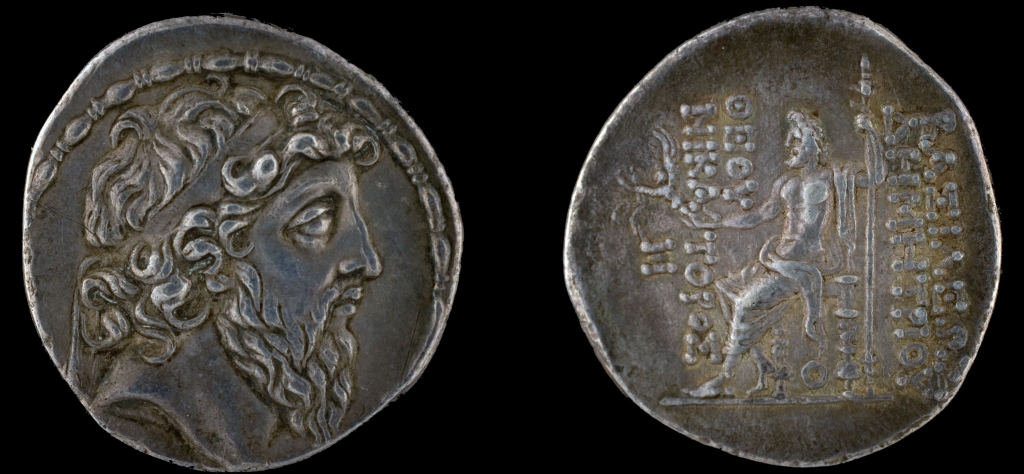
Silver Tetradrachm of Demetrios (Demetrius) II Nikator, Syria, 15.79 g.
Title
Silver Tetradrachm of Demetrios (Demetrius) II Nikator, Syria, 15.79 g.
Creator
Demetrios (Demetrius) II Nikator, Syria
Date
c. 129-125 BCE
Description
Obverse: In laurel wreath, diademed head of Demetrios facing right.
Reverse: Zeus Nikephoros enthroned facing left, with flying Nike in right hand and scepter in left hand; beneath throne, Ο; monogram in left field; ΒΑΣΙΛΕΩΣ ΔΗΜΗΤΡΙΟΥ ΘΕΟΥ ΝΙΚΑΤΟΡΟΣ: of King Demetrios, God, Conquerer.
Style/Period: Hellenistic
The eldest son of Demetrios I, Demetrios II came to the throne in 146 BCE, after killing a pretender to the throne who had killed his father. Demetrios ruled a much reduced territory for six years, until he made war with Parthia and was taken prisoner. He was held hostage in luxury for ten years. In 129 BCE he returned to Syria for a second reign that lasted until his death in 125 BCE.
The coins of Demetrios' first reign depicted a clean-shaven ruler who used the traditional Seleukid "Apollo-on-omphalos" type on the reverse (see 91.090), but the coins of his second reign show clear evidence of his time in Parthia, for he wears the long hair and beard of Parthian fashion, which he apparently adopted in captivity. The type, presumably somewhat realistic, stands in sharp contrast to his predecessors' types, which are more idealized in the manner of portraits of Alexander the Great.
The Zeus holding Nike on the reverse indicates that the Seleukids are reclaiming Zeus as a patron deity. The same reverse type had been used by Antiochos IV Epiphanes, who adopted Zeus as his patron deity, but it was usurped by the pretender Alexander Balas, who claimed to be the son of Antiochos.
-- Kristin J. Brainard Addington, LU '94
Bibliography: N. Davis and C.M. Kraay, The Hellenistic Kingdoms: Portrait Coins and History (London 1973) 217-218.
Source
Former collection of Ottilia Buerger. Bought from Hesperia Art, March 26, 1960.
Identifier
91.093
Rights
Wriston Art Center Galleries, Lawrence University, Appleton, WI,wriston-gallery@lawrence.edu,920-832-6890
Subject
Hellenistic, diadem, Demetrios, Zeus Nikephoros, Nike, scepter, Demetrios II Nikator, Demetrius II Nikator, Syria
Files
Citation
Demetrios (Demetrius) II Nikator, Syria, “Silver Tetradrachm of Demetrios (Demetrius) II Nikator, Syria, 15.79 g.,” Lawrence University Classics Department & Ottilia Buerger Coin Collections, accessed November 5, 2026, https://thor.lawrence.edu/omeka/buerger/items/show/226.