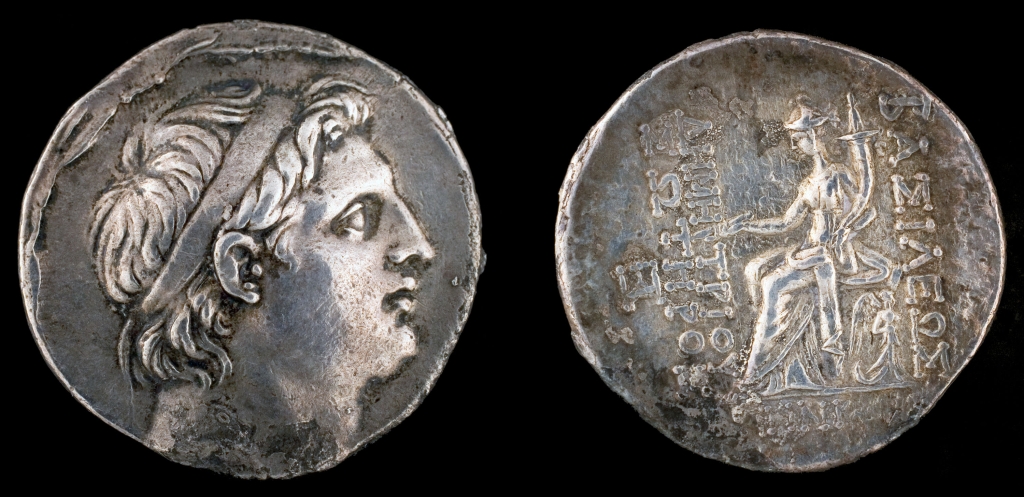
Silver Tetradrachm of Demetrios (Demetrius) I Soter, Syria, 16.24 g.
Title
Silver Tetradrachm of Demetrios (Demetrius) I Soter, Syria, 16.24 g.
Creator
Demetrios (Demetrius) I Soter, Syria
Date
155-154 BCE
Description
Obverse: In laurel wreath, diademed head of Demetrios facing right.
Reverse: Tyche seated facing left, holding short scepter in right hand and cornucopia in left hand; Nereid beside throne; monogram in left field. ΗΡΝ (the date in the Seleukid Era = 155-154 B.C.E.) in exergue; ΒΑΣΙΛΕΩΣ ΔΗΜΗΤΡΙΟΥ ΣΩΤΗΡΟΣ: of Demetrios the Savior.
Style/Period: Hellenistic
Demetrios I Soter, the son of King Seleukos IV, was given over as a hostage to Rome in place of his uncle, who took the throne as Antiochos IV when Seleukos died. But when Antiochos died and his child was put on the throne, Demetrios escaped from Rome and in 162 BCE returned to claim the Seleukid throne. He set out to reconquer the Babylonian territory that had been lost to the kingdom, thereby earning the title Soter or Saviour. In 150 BCE Demetrios was killed in battle against a coalition of neighboring states.
Demetrios' portrait on his early coins had appeared fairly realistic, but toward the end of his reign he introduced this idealized type, retaining something of the beaked nose of the earlier versions, but with the upward gaze and the anastole and flowing hair alluding to portraits of Alexander. The laurel wreath around the head refers to Apollo, the patron deity of the Seleukid dynasty down to the reign of Demetrios' father (see 91.090). The reference to Apollo is probably also meant to signal the return of legitimate rule, since Antiochos IV had made Zeus Olympios his patron deity.
The figure on the reverse is Tyche or Fortune, a popular divinity of the Hellenistic period and patron goddess of the Seleukid capital of Antioch, where these coins were issued. She wears the turreted crown of the city goddess.
-- Kristin J. Brainard Addington, LU '94
Bibliography: E.T. Newell, The Seleucid Mint at Antioch (New York 1918) 34-46; G.K. Jenkins, "Notes on Seleucid Coins," Numismatic Chronicle 19 (1951) 2-5.
Source
Former collection of Ottilia Buerger. Bought from Hesperia Art, Dec. 12, 1959.
Identifier
91.092
Rights
Wriston Art Center Galleries, Lawrence University, Appleton, WI,wriston-gallery@lawrence.edu,920-832-6890
Subject
Hellenistic, laurel wreath, diadem, Demetrios, Tyche, scepter, cornucopia, Nereid, Demetrios I Soter, Demetrius I Soter, Syria
Files
Citation
Demetrios (Demetrius) I Soter, Syria, “Silver Tetradrachm of Demetrios (Demetrius) I Soter, Syria, 16.24 g.,” Lawrence University Classics Department & Ottilia Buerger Coin Collections, accessed November 5, 2026, https://thor.lawrence.edu/omeka/buerger/items/show/225.