Silver Tetradrachm of Syracuse, Sicily, Italy, 17.05 g.
Title
Silver Tetradrachm of Syracuse, Sicily, Italy, 17.05 g.
Creator
Syracuse, Sicily, Italy
Date
c. 410 BCE
Description
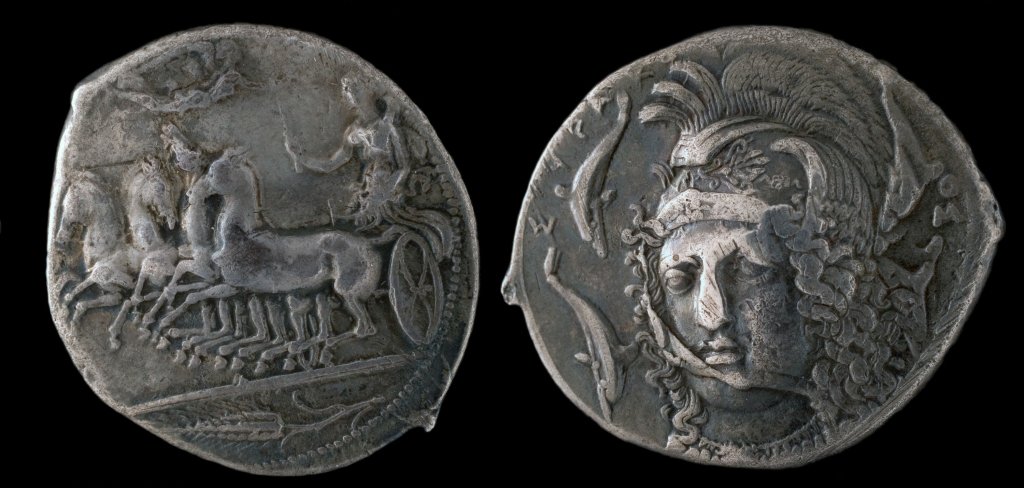
Obverse: Racing quadriga facing left, Nike flying above horses facing right; in exergue, an ear of barley.
Reverse: Facing head of Athena wearing necklace and triple-crested helmet with raised cheek-pieces; signature of Eukleidas on helmet bowl; ΕΥΚΛΕΙΔ(ΑΣ): Eukleidas; ΣΥΡΑΚΟΣ [ΙΩΝ]: of the Syracusans.
Style/Period: Greek (ancient)
This coin was signed by one of the great Syracusan die-engravers, Eukleidas; his abbreviated signature is just legible on the reverse, on the bowl of Athena's helmet. Like the contemporary head of Arethusa on Kimon's Syracusan tetradrachm (see 93.007), the head is facing and surrounded by dolphins, by this time a common feature of Syracusan coins. The delicacy and detail of Athena's face are somewhat marred by a break in the die that cuts across her chin.
The depiction of Athena is unusual on Syracusan coins, which typically use heads of the local nymph Arethusa or of their major deities Demeter and Persephone, but there was also a temple to Athena in Syracuse, dedicated after the Syracusans defeated the Carthaginians in the battle of Himera in 480 BCE It has been suggested that it was appropriate to recall it at this time, when Syracuse was once again faced with a Carthaginian invasion, as one Sicilian city after another fell to her old enemy.
The obverse depicts the racing quadriga that had long been the main type on Syracusan coins. The spirited horses toss their heads backward and from side to side, and the fallen marker beneath their hooves gives a sense of immediacy to the race. The foreshortened wheel of the quadriga also adds an impression of depth.
-- Carol L. Lawton
Bibliography: L.O. Th. Tudeer, Die tetradrachmenprägung von Syrakus in der Periode der signierenden Künstler (Berlin 1913), 59; C.M. Kraay, Archaic and Classical Greek Coins (Berkeley and Los Angeles 1976).
Source
Former collection of Ottilia Buerger. Purchased from Harlan Berk, 03-Jun-1992.
Identifier
93.005
Rights
Wriston Art Center Galleries, Lawrence University, Appleton, WI,wriston-gallery@lawrence.edu,920-832-6890
Subject
Greek, quadriga, horse, Nike, barley, Athena, helmet, signature, Eukleidas, Syracuse, Sicily, Italy
Files
Citation
Syracuse, Sicily, Italy, “Silver Tetradrachm of Syracuse, Sicily, Italy, 17.05 g.,” Lawrence University Classics Department & Ottilia Buerger Coin Collections, accessed November 5, 2026, https://thor.lawrence.edu/omeka/buerger/items/show/186.