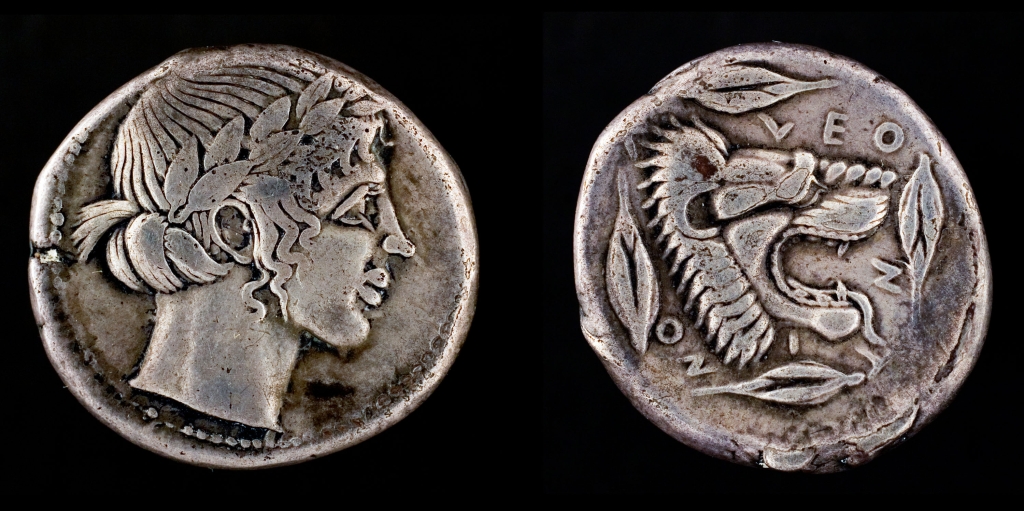
Silver Tetradrachm of Leontini (Leontinoi), Sicily, Italy, 17.15 g.
Title
Silver Tetradrachm of Leontini (Leontinoi), Sicily, Italy, 17.15 g.
Creator
Leontini (Leontinoi), Sicily, Italy
Date
c. 460 BCE
Description
Obverse: Head of Apollo facing right, wearing laurel wreath with three rows of leaves.
Reverse: Lion's head facing right, surrounded by four barley grains; ΛΕΟΝΤΙΝΟΝ: of the Leontines.
Style/Period: Greek (ancient)
Leontinoi was founded in 729 BCE by the colony of Naxos, which had been settled by the Chalkidians six years earlier. Located on a broad, fertile plain inland from the eastern coast of Sicily, Leontinoi was known for its agriculture and grew prosperous exporting grain to Greece and to other towns in Sicily.
The coinage of Leontinoi begins in the early fifth century, when it was ruled by tyrants dependent upon Syracuse; its coinage shows strong Syracusan influence. In 466 B.C. the tyrannies at Syracuse and apparently also at Leontinoi were overthrown, and Leontinoi replaced the Syracusan symbol of the quadriga (see 91.029, 91.032, 91.033, 93.005, 93.007) with the head of its patron god, Apollo, on the obverse of its coins. The coins continued unchanged but for stylistic development until 422 BCE, when Leontinoi again became subject to Syracuse.
Apollo, the main god of the Chalkidians, was brought to Leontinoi at the time of its settlement. The head of Apollo on this tetradrachm has elements of the Severe Style typical of Greek sculpture from c. 480-450 BCE, the plain hair brushed toward the forehead and the heavy, prominent chin, and should therefore be dated c. 460 BCE, early in the period of Leontinoi's independence. The lion on the reverse is both an animal associated with Apollo and a play on the name of the town; leon is the Greek word for lion. The grains of barley surrounding the lion's head refer to the agricultural importance of Leontinoi; earlier coins of Leontinoi show the barley corns encircling the head of Apollo in much the same way that dolphins surround the heads of Arethusa and Athena on Syracusan coins (see 91.029, 91.032, 91.033, 93.005, 93.007).
-- Kathleen L. Metzger Newmyer, LU '94
Bibliography: C.M. Kraay, Archaic and Classical Greek Coins (Berkeley and Los Angeles 1976) 211-212, pl. 49.
Source
Former collection of Ottilia Buerger. Ex Fred V. Fowler collection; Stack's, 1969.
Identifier
91.025
Rights
Wriston Art Center Galleries, Lawrence University, Appleton, WI,wriston-gallery@lawrence.edu,920-832-6890
Subject
Greek, god, Apollo, wreath, lion, barley, grain, Leontini, Leontinoi, Sicily, Italy
Files
Citation
Leontini (Leontinoi), Sicily, Italy, “Silver Tetradrachm of Leontini (Leontinoi), Sicily, Italy, 17.15 g.,” Lawrence University Classics Department & Ottilia Buerger Coin Collections, accessed November 5, 2026, https://thor.lawrence.edu/omeka/buerger/items/show/185.