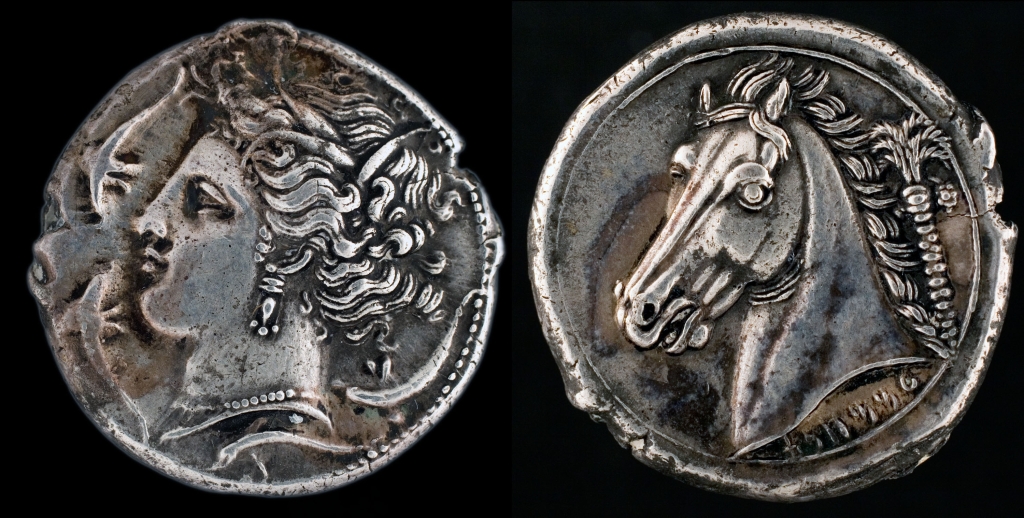
Silver Tetradrachm of Carthage (Siculo-Punic), Zeugitana, Tunisia, 17.08 g.
Title
Silver Tetradrachm of Carthage (Siculo-Punic), Zeugitana, Tunisia, 17.08 g.
Creator
Carthage (Siculo-Punic), Zeugitana, Tunisia
Date
c. 350-325 BCE
Description
Obverse: Head of Arethusa facing left, wearing triple-drop earring, necklace, and wreath of reeds, surrounded by four dolphins.
Reverse: Head of horse facing left, palm tree; MMHNT in Punic letters: People of the Camp.
Style/Period: Carthaginian (ancient)
Carthage, a Phoenician settlement on the coast of northern Africa, began to compete with the Greeks for control of Sicily in the fifth century BCE Its interference there eventually led to the Battle of Himera in 480 BCE, in which combined Greek forces soundly defeated the Carthaginians. The Carthaginians returned at the end of the fifth century, destroying Himera and other Sicilian cities. The Syracusans resisted them throughout the fourth century, confining them to the western part of the island, where they minted coins to pay their troops. The coins are therefore called Siculo-Punic; the term Punic to refer to the Carthaginians comes from the Latin Punicus, meaning Phoenician.
For the Siculo-Punic coins, the Carthaginians adopted a combination of Greek and Carthaginian types, with Punic inscriptions like the one on this tetradrachm, apparently indicating the minting authority, "the people of the camp." The Arethusa type by Euainetos on Syracusan dekadrachms of the early fourth century (see 91.032) was used as a model for the obverse. The head is very close in all its details to the original, but the thick chin and lack of definition in the dolphins identify it as an imitation. The close copying of this type suggests that the Carthaginians wanted these coins to circulate freely among the Greek coins of Sicily.
The reverse is a Carthaginian type. The horse's head probably refers to a foundation legend of Carthage, in which the future site of the city was determined by the discovery of a horse's head (Virgil, Aeneid 1. 441-444). It may also refer to the military use of the coinage. The palm tree, phoenix in Greek, is a punning type that would permit Greeks to identify the coin as Phoenician.
-- Kathleen L. Metzger Newmyer, LU '94
Bibliography: G.K. Jenkins, "Coins of Punic Sicily," Part 3, Schweizerische Numismatische Rundschau 56 (1977) 5-65.
Source
Former collection of Ottilia Buerger. Ex Fred V. Fowler collection; Stack's, 1969.
Identifier
91.041
Rights
Wriston Art Center Galleries, Lawrence University, Appleton, WI,wriston-gallery@lawrence.edu,920-832-6890
Subject
Carthaginian, Arethusa, wreath, dolphins, palm tree, Carthage, Siculo-Punic, Zeugitana, Tunisia
Files
Citation
Carthage (Siculo-Punic), Zeugitana, Tunisia, “Silver Tetradrachm of Carthage (Siculo-Punic), Zeugitana, Tunisia, 17.08 g.,” Lawrence University Classics Department & Ottilia Buerger Coin Collections, accessed November 5, 2026, https://thor.lawrence.edu/omeka/buerger/items/show/168.