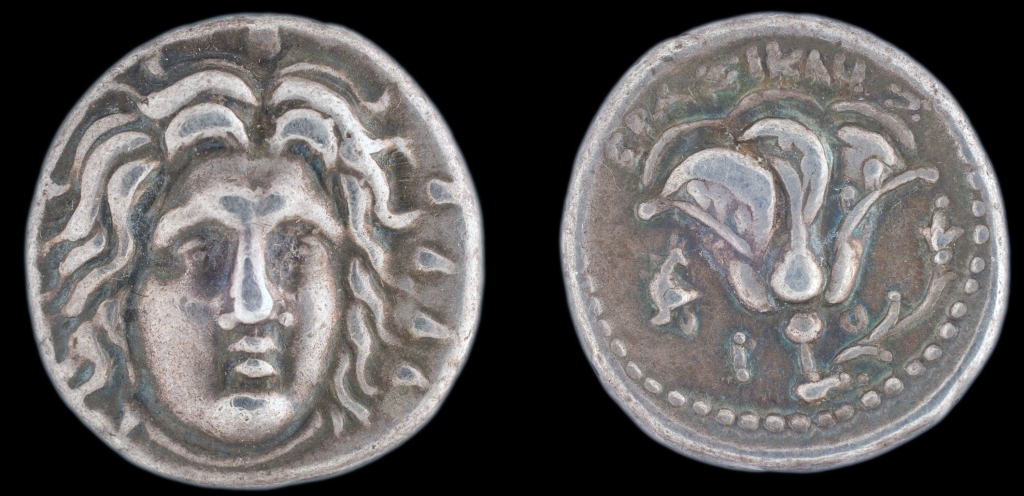
Silver Didrachm of Rhodus (Rhodes), Dodecanese, Greece, 6.76 g.
Title
Silver Didrachm of Rhodus (Rhodes), Dodecanese, Greece, 6.76 g.
Creator
Rhodus (Rhodes), Dodecanese, Greece
Date
c. 333-304 BCE
Description
Obverse: Facing radiate head of Helios.
Reverse: Rose; in left field, helmet; on either side of flower, Ρ-Ο: abbreviation for Rhodes; ΕΡΑΣΙΚΛΗΣ: Erasikles, name of magistrate.
Style/Period: Greek (ancient)
In the late fifth century BCE the three independent cities of the island of Rhodes, Lindos, Kamiros and Ialysos, united and founded a new capital city, also named Rhodes. The coins of the new capital depicted the island's main deity, the sun god Helios, on the obverse and a rose (in Greek rhodos), a play on the name Rhodes, on the reverse.
According to legend, when Zeus forgot Helios as he was dividing the islands among the gods, Helios said that he would take an island then rising from the sea, Rhodes. His children with the nymph Rhodos became rulers of the island, and the island's three cities were named after them. The cult of Helios was an important one in Rhodes. The island's most famous monument, the Colossos, was a bronze statue of Helios by Chares of Lindos, a pupil of Lysippos. It stood some 32 m. high at the entrance to the city's harbour. The facing head of Helios on Rhodian coins was probably inspired by Kimon's famous facing head of the nymph Arethusa on Syracusan coins (see 93.007). In both heads the hair spreads outward, in Helios changing into the rays of the sun.
The coins of Rhodes had an interesting life in the Middle Ages. At that time it was thought that the head of Helios was the head of Christ, that the rose was the rose of Sharon, and that the coins were the thirty pieces of silver paid to Judas.
-- Rebecca H. Luhmann Levine, LU '93
Bibliography: C.M. Kraay, Greek Coins (New York 1966).
Source
Former collection of Ottilia Buerger. Bought from Edward Gans, 1959.
Identifier
91.085
Rights
Wriston Art Center Galleries, Lawrence University, Appleton, WI,wriston-gallery@lawrence.edu,920-832-6890
Subject
Greek, Helios, rose, helmet, Rhodus, Rhodes, Dodecanese, Greece
Files
Citation
Rhodus (Rhodes), Dodecanese, Greece, “Silver Didrachm of Rhodus (Rhodes), Dodecanese, Greece, 6.76 g.,” Lawrence University Classics Department & Ottilia Buerger Coin Collections, accessed November 5, 2026, https://thor.lawrence.edu/omeka/buerger/items/show/167.