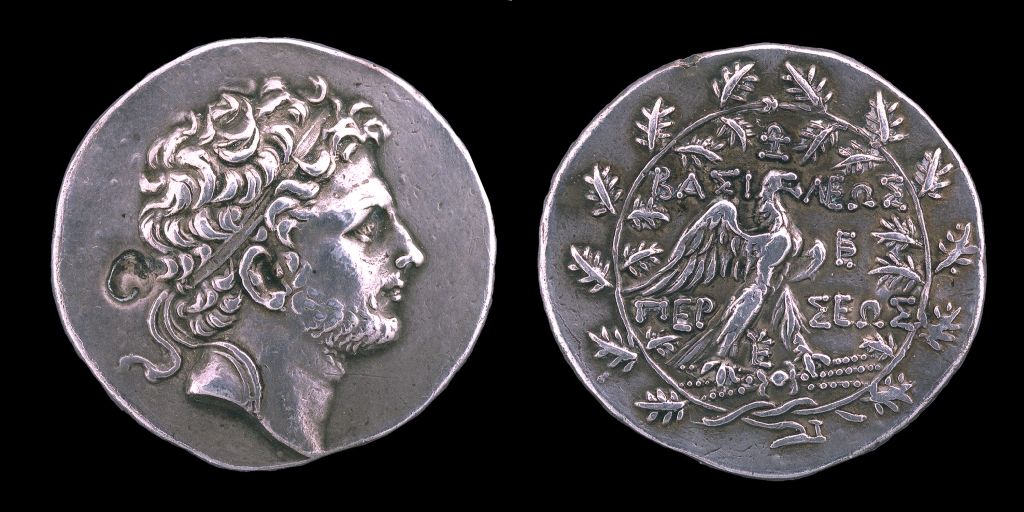
Silver Tetradrachm of Perseus, Macedon, 15.46 g.
Title
Silver Tetradrachm of Perseus, Macedon, 15.46 g.
Creator
Perseus, Macedon
Date
171–168 BCE
Description
Obverse: Bearded and diademed head of Perseus facing right
Reverse: In oak wreath, eagle on thunderbolt on right; monograms above eagle and in right field; below wreath, plough; ΒΑΣΙΛΕΩΣ ΠΕΡΣΕΩΣ: of King Perseus.
Style/Period: Hellenistic
Perseus, the last Macedonian king, succeeded his father, Philip V, in 179 BCE From the beginning he was careful in securing allies against his greatest threat, Eumenes II of Pergamon. He renewed a treaty with Rome, which treated him as an ally until Eumenes convinced Rome to declare war against Perseus in 171 BCE The conflict dragged on for three years, until the Roman commander, Aemilius Paullus, confronted Perseus at Pydna in Macedonia, where the Macedonian army was slaughtered. Perseus eventually surrendered to the Romans and died in captivity in Rome. Macedonia was divided into four powerless republics, and the kingdom of Alexander the Great ceased to exist.
The portrait on the obverse is presumably realistic, since it includes distinctive features such as the sloping forehead, prominent nose, and short, wispy beard, and has few of the idealizing qualities common to Hellenistic coin portraits inspired by those of Alexander the Great. The eagle on the thunderbolt and the oak wreath of the reverse refer to Zeus, a patron deity of Macedonian royalty since Alexander.
The relatively light weight of this tetradrachm suggests that it was issued while Perseus waged war with Rome, since at the end of his reign he apparently reduced the weight standard of the coins in order to meet the financial demands of paying his army.
-- Kristin J. Brainard Addington, LU '94
Bibliography: N. Davis and C.M. Kraay, The Hellenistic Kingdoms: Portrait Coins and History (London 1973) 228-229.
Source
Former collection of Ottilia Buerger. Ex Fred V. Fowler collection; Stack's, 1969.
Identifier
91.061
Rights
Wriston Art Center Galleries, Lawrence University, Appleton, WI,wriston-gallery@lawrence.edu,920-832-6890
''
Files
Citation
Perseus, Macedon, “Silver Tetradrachm of Perseus, Macedon, 15.46 g.,” Lawrence University Classics Department & Ottilia Buerger Coin Collections, accessed November 5, 2026, https://thor.lawrence.edu/omeka/buerger/items/show/590.