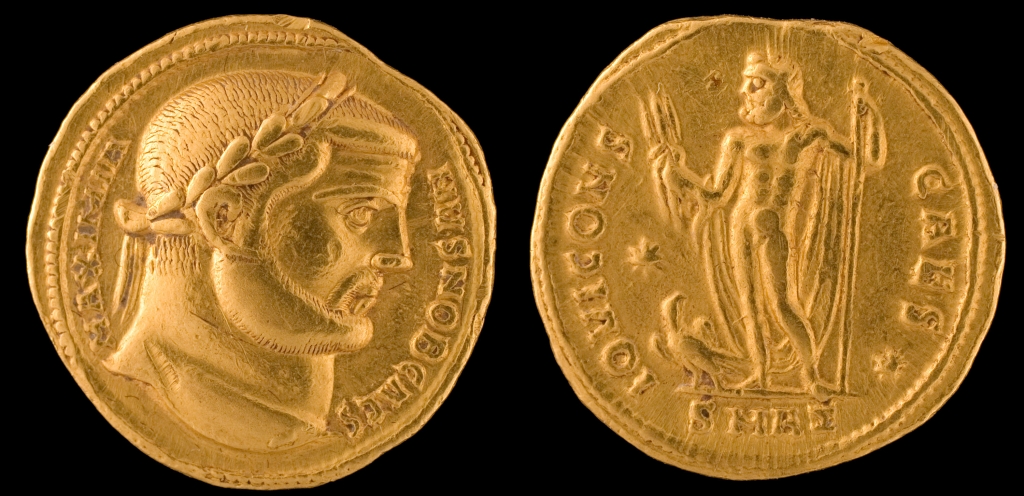
Gold Aureus of Galerius (Galerius Maximianus), 5.30 g.
Title
Gold Aureus of Galerius (Galerius Maximianus), 5.30 g.
Creator
Galerius (Galerius Maximianus)
Date
293–295 CE
Description
Obverse: Laureate bust of Galerius; MAXIMIANVS NOB CAES.
Reverse: Jupiter standing facing, chlamys spread behind torso, right hand holding thunderbolt, left hand leaning on scepter, eagle at feet to left; IOVI CONS CAES; mint mark in exergue.
Style/Period: Roman Empire
Galerius Valerius Maximianus, more commonly known as Galerius, was an emperor of Rome from 293 CE and 305 CE, during an era known as the Tetrarchy. The Tetrarchy began when the emperor Diocletian and his colleague Maximian realized that the empire was too large for a single emperor. As such Diocletian decreed that it would be ruled simultaneously by four men in order to handle the massive administrative and military responsibilities. Diocletian and Maximian were the senior emperors, or Augusti, with Galerius and Constantius as junior emperors, or Caesars. The reverse of this coin shows how the Tetrarchy used religion to cement its authority. Galerius and Diocletian used Jupiter as their patron deity, while Maximian and Constantius used Hercules. This helped to justify their actions, as they were sanctioned by the gods. On this coin “IOVI” or Jupiter is seen with a lightning bolt, scepter and eagle, which are all symbols of Jupiter.
The obverse does not use religion but the portrait itself to display power. The strong jaw and square head give the impression of a powerful figure. In addition, his beard is closely cropped and would have been common in the military, further showing his discipline and dominance. In their art the Tetrarchs removed many individualizing features to perpetuate the idea to the public that they were a single entity that ruled with divine authority.
--McKinley Breen, LU `21
Bibliography: D. Kleiner, Roman Sculpture (New Haven 1992), 400-401; C. Foss, Roman Historical Coins (London 1990), 260; H. Cohen, Latin Epigraphy II: The Coin Inscriptions and Epigraphical Abbreviations of Imperial Rome (Chicago 1978), XLIII; J P.C. Kent, Roman Coins (New York 1978), 46; C.H.V. Sutherland and R.A.G. Carson, The Roman Imperial Coinage, Vol. VI (London 1967), 613.
Source
Former collection of Ottilia Buerger. Purchased from Abner Kreisberg, January 30, 1960.
Identifier
91.238
Rights
Wriston Art Center Galleries, Lawrence University, Appleton, WI,wriston-gallery@lawrence.edu,920-832-6890
''
Files
Citation
Galerius (Galerius Maximianus), “Gold Aureus of Galerius (Galerius Maximianus), 5.30 g.,” Lawrence University Classics Department & Ottilia Buerger Coin Collections, accessed November 5, 2026, https://thor.lawrence.edu/omeka/buerger/items/show/582.