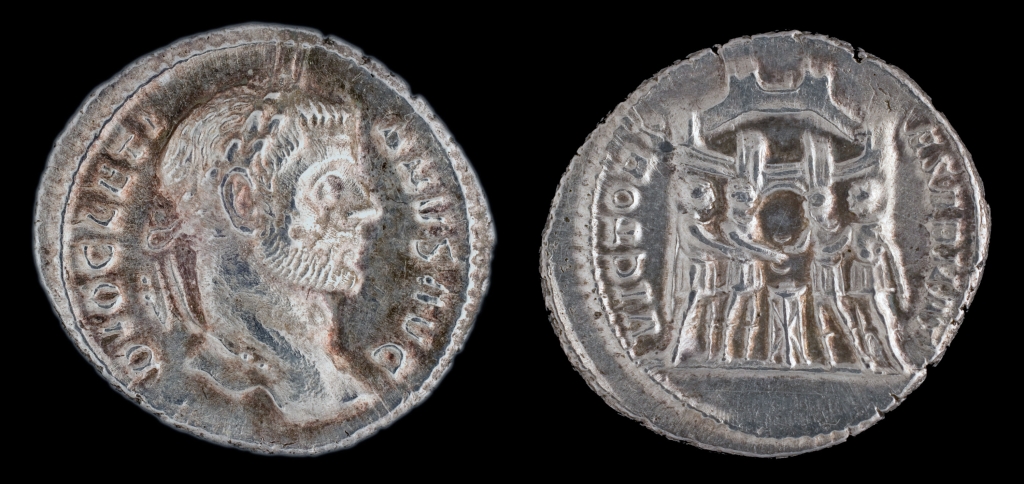
Silver Argenteus of Diocletian, 3.11 g.
Title
Silver Argenteus of Diocletian, 3.11 g.
Creator
Diocletian
Date
294 CE
Description
Obverse: Laureate bust of Diocletian; DIOCLETIANVS AVG.
Reverse: Tetrarchs sacrificing over a tripod before the gate of a six-turreted structure; VICTORIA SARVAT.
Style/Period: Roman Empire
Diocletian was proclaimed emperor on September 17, 284 CE. At the time the Roman empire had gone through 50 years of anarchy with dozens of claimants to the throne. However, Diocletian defeated the last of these soldier emperors in mid-285 CE and set about restoring the imperial power of Rome. These steps included expanding the imperial college from a single ruler to eventually four, in what we know as the Tetrarchy. The Tetrarchy used its coinage to show strength and unity. The obverse of this coin shows his portrait in full Tetrarchic fashion, with his eyes deep-set and his head almost rectangular, with a military-style beard and a strong jaw. It would have been the face of a very powerful and disciplined man. Additionally, there are almost no distinguishing characteristics between this portrait and those of other Tetrarchs, thus demonstrating their unity.
The reverse of this coin also attempts to solidify the Tetrarchy’s unification and military might. All four of them are situated around a turreted enclosure, sacrificing on an altar. The enclosure is reminiscent of a military fort, thus showing their connection with the army, and they each wear military uniforms. Meanwhile the altar indicates their divine right to rule. Additionally, “VICTORIA SARMAT” is inscribed, meaning victory over the Sarmatians. They were a Steppe tribe in central Europe that had been attacking Roman territory for several decades. With this declaration he is able to show the people of the empire the Tetrarchy’s military success. Furthermore, just as the portrait has no distinguishing features, the same is true on the reverse. There is no way to distinguish the four men; they are even the same height. All of this was to project the power of the Tetrarchy. It was not four men ruling simultaneously, but four men ruling together as a single entity.
--McKinley Breen, `21
Bibliography: C. Foss Roman Historical Coins (London 1990), 250-251; C.H.V. Sutherland and R.A.G. Carson, The Roman Imperial Coinage, Vol. VII (London 1984), 442, 459; J.P.C Kent, Roman Coins (New York 1978), 46-48; L. Breglia, Roman Imperial Coins: Art and Technique. (New York 1968), 202.
Source
Former collection of Ottilia Buerger. Purchased from Fred Knobloch, February 1968.
Identifier
91.234
Rights
Wriston Art Center Galleries, Lawrence University, Appleton, WI,wriston-gallery@lawrence.edu,920-832-6890
''
Files
Citation
Diocletian, “Silver Argenteus of Diocletian, 3.11 g.,” Lawrence University Classics Department & Ottilia Buerger Coin Collections, accessed November 5, 2026, https://thor.lawrence.edu/omeka/buerger/items/show/580.