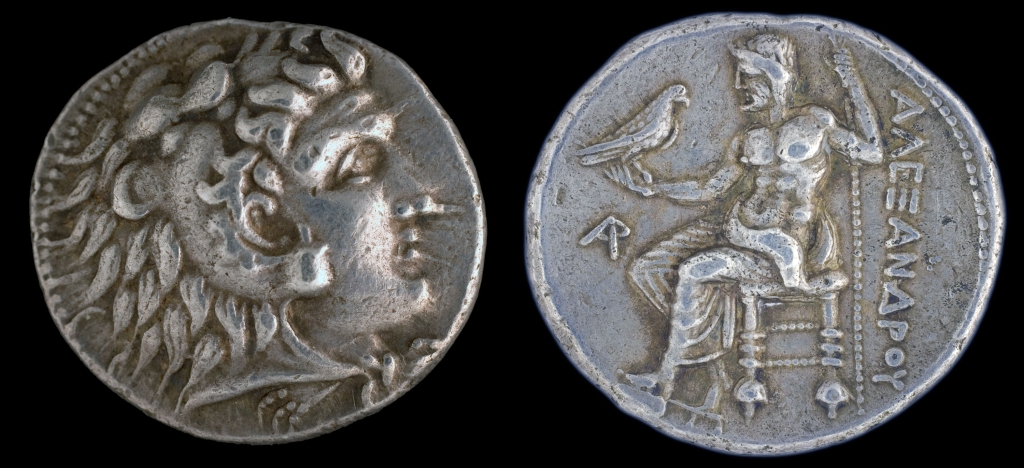
Silver Tetradrachm of Alexander III, Macedon (Macedonia), 17.17 g.
Title
Silver Tetradrachm of Alexander III, Macedon (Macedonia), 17.17 g.
Creator
Alexander III, Macedon (Macedonia)
Date
c. 336-323 BCE
Description
Obverse: Head of Herakles in a lion-skin cap.
Reverse: Seated Zeus with scepter in left hand and eagle in right hand. To right, ΑΛΕΞΑΝΔΡΟΥ (Alexandrou): of Alexander. To left, mint monogram ΑΡ.
Style/Period: Hellenistic
This was the first coin Alexander minted after the death of his father, Philip II. The obverse displays Herakles, the fabled ancestor of the Macedonian royal family, in a lion-skin cap, which refers to the first of his labors, the killing of the Nemean lion. The reverse depicts Zeus with a scepter in his left hand, signifying his divine right to rule, and his attribute an eagle in his right hand. The symbol on the reverse, a combined A and P, is the mark of the place that minted it, which was Aradus, in Phoenicia.
This was one of the first Macedonian coins to be minted in the Attic standard, the standard of Athens, rather than the Persic standard; Alexander’s adoption of the Attic standard caused Athenian coins to spread far and wide. Alexander's choice of Herakles as the obverse image not only referred to his mythological ancestor, but it also helped his reputation in the eyes of the Greeks, as the image was recognizable and acceptable to them. However, after the death of Alexander in 323 BCE, the image was frequently referred to as Alexander instead of Herakles.
- Jessica L. Hoyer, LU '17
Bibliography: B. V. Head, Historia Numorum (Chicago reprint 1967) 225, 788-789; C. M. Kraay, Archaic and Classical Greek Coins (Berkeley 1976) 77; O. Mørkholm, Early Hellenistic Coinage: from the Accession of Alexander to the Peace of Apamea (336-188 B.C.), eds. P. Grierson and U. Westermark (Cambridge 1991) 27, 43, figs. 9, 10.
Source
Former collection of Ottilia Buerger. Purchased from Coin Galleries, January 21, 1971.
Identifier
91.052
Rights
Wriston Art Center Galleries, Lawrence University, Appleton, WI,wriston-gallery@lawrence.edu,920-832-6890
Files
Citation
Alexander III, Macedon (Macedonia), “Silver Tetradrachm of Alexander III, Macedon (Macedonia), 17.17 g.,” Lawrence University Classics Department & Ottilia Buerger Coin Collections, accessed November 5, 2026, https://thor.lawrence.edu/omeka/buerger/items/show/418.