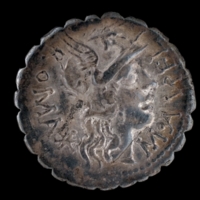
Marcus Aurelius Scaurus with L. Licnius Crassus and Cn. Domitius Ahenobarbus, silver denarius serratus, 3.82 g.
Title
Marcus Aurelius Scaurus with L. Licnius Crassus and Cn. Domitius Ahenobarbus, silver denarius serratus, 3.82 g.
Creator
Marcus Aurelius Scaurus; Licnius Crassus; Cn. Domitius Ahenobarbus
Date
c. 118 BCE
Description
Obverse: Head of Roma facing right, with winged Phrygian helmet ornamented with griffin's head; to left, ROMA downwards and star; to right, M AVRELI upwards. Border of dots.
Reverse: Nude Gallic warrior in biga right, hurling spear in right hand, with Gallic shield, carnyx and reins in left hand; below, SCAVRI; in exergue, L LIC CN [DOM]. Border of dots.
Style/Period: Roman Republic
Marcus Aurelius Scaurus was one of five minting magistrates chosen during 118 BCE. This coin commemorates the foundation of the colony of Narbo Martius in Gaul in 118. L. Licinius Crassus and Cn. Domitius Ahenobarbus were elected as the colony's duoviri or founding commissioners. Mattingly believes that all three men were questori urbani rather than triumviri monetales. The reverse of the coin commemorates the victory of Cn. Domitius Ahenobarbus that allowed the colony to be formed. The warrior in the biga is most likely King Bituitus of Averni who was captured in 121 by C. Fabius Maximus. In the resulting triumph, Bituitus stood in a silver chariot. This coin is one of the first known examples of a serrated coin. Serrated coins were made by creating notches in the edge of the coin at irregular angles before the coin was struck. Serrations were often believed to be used to prove that a coin was of pure metal and not plated; however, some plated coins were also serrated. Since serrated coins were principally meant for circulation outside Italy, the serrated edge probably provided the native populations a means of easily identifying a coin as legal tender.
-- Bradford W. Wendel, LU '96
Bibliography: E. Babelon, Description historique et chronologique des monnaies de la republique romaine (Paris and London 1885-1886) Aurelia, 20; J. de Witte, "L'Arc triomphe d'Orange," Revue Archélogique 10/2 (1887) 134-136; H. A. Grueber, Coins of the Roman Republic in the British Museum (London 1910), I, 184-185, no. 1185; H. Mattingly, "Some Historical Coins of the Late Republic," Journal of Roman Studies (1922) 230-239; H. Mattingly, "The Roman 'Serrati'," Numismatic Chronicle 4 (1924) 31-52; E. A. Sydenham and L. A. Lawrence, "The Origin of the Roman Serrati," Numismatic Chronicle 15 (1935) 209-231; T. R. S. Broughton, The Magistrates of the Roman Republic, II (New York 1952) 432, 560, 579; E. A. Sydenham, The Coinage of the Roman Republic (London 1952) 65, no. 523; E. Badian, Studies in Greek and Roman History (Oxford 1964) 101, n. 98; C. H. V. Sutherland, Roman Coins (New York 1974) 62, nos. 85-86; M. H. Crawford, Roman Republican Coinage (London 1974), 298-299, no. 282/1; R. A. G. Carson, Principal Coins of the Romans, I (London 1978) 36, no. 104; C. Foss, Roman Historical Coins (London 1990) 2, no. 2a.
Source
Classics Department Collection
Identifier
C013
Rights
Wriston Art Center Galleries, Lawrence University, Appleton, WI,wriston-gallery@lawrence.edu,920-832-6890
Files
Citation
Marcus Aurelius Scaurus; Licnius Crassus; Cn. Domitius Ahenobarbus, “Marcus Aurelius Scaurus with L. Licnius Crassus and Cn. Domitius Ahenobarbus, silver denarius serratus, 3.82 g.,” Lawrence University Classics Department & Ottilia Buerger Coin Collections, accessed November 5, 2026, https://thor.lawrence.edu/omeka/buerger/items/show/373.