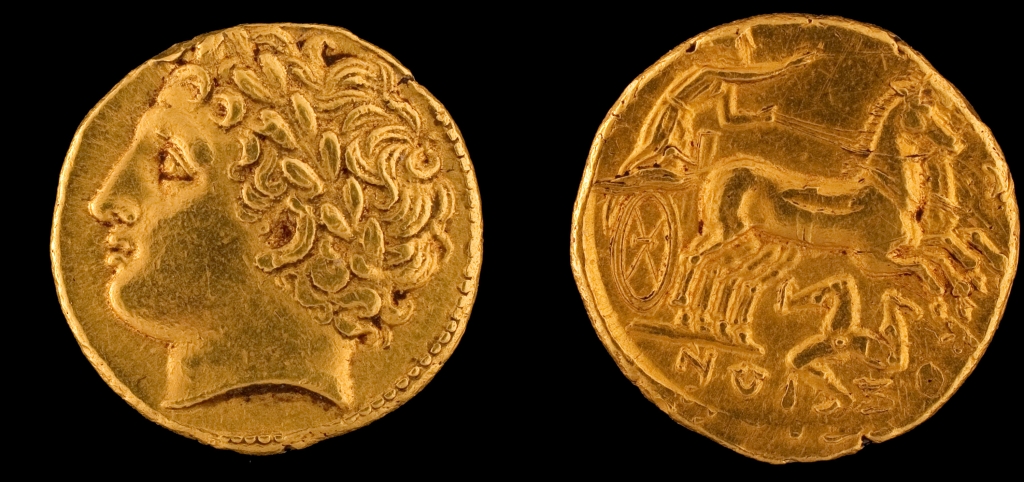
Gold Drachm of Syracuse, 4.29 g.
Title
Gold Drachm of Syracuse, 4.29 g.
Creator
Syracuse, Sicily, Italy
Date
c. 317-310 BCE
Description
Obverse: Head of Apollo to left, wearing laurel wreath.
Reverse: Biga in full gallop to right; below, triskeles; ΣΥΡΑΚΟΣΙΩΝ: of the Syracusans.
Style/Period: Early Hellenistic
Agathokles, the tyrant of Syracuse from 317 until 289 BCE, borrowed the types for this coin from the gold staters of Philip II of Macedon and his successors (see coin 91.058), thereby establishing a currency immediately recognizable throughout the Greek world. He also issued staters that were influenced by the coinage of Alexander the Great (see coin 91.035).
The general types are also very similar to those of Philip’s coins. Apollo, depicted on the obverse, was also important in his own right in Syracuse; he had had a temple there since the early sixth century. The head of Apollo has the fleshiness and intensity in the eyes that are often associated with portraits of Alexander the Great and that became widespread characteristics of late-fourth-century heads. The racing biga here, as on Philip’s coins, could refer generally to Agathokles’ victories over the Carthaginians. Whereas Philip had placed his name in the exergue of the reverse, Agathokles put his own personal stamp, the three-legged symbol called triskeles, beneath the horses of the reverse. This coin is usually dated to the early part of his rule.
-- Kelly Swett Riordan, LU '93
Bibliography: G. K. Jenkins, “Electrum Coinage at Syracuse,” in Essays in Greek Coinage presented to Stanley Robinson, C. M. Kraay and G. K. Jenkins, eds. (Oxford 1968) 145-162.
Source
Former collection of Ottilia Buerger. Purchased from Abner Kreisberg, October 14, 1971
Identifier
91.036
Rights
Wriston Art Center Galleries, Lawrence University, Appleton, WI,wriston-gallery@lawrence.edu,920-832-6890
Files
Citation
Syracuse, Sicily, Italy, “Gold Drachm of Syracuse, 4.29 g.,” Lawrence University Classics Department & Ottilia Buerger Coin Collections, accessed November 5, 2026, https://thor.lawrence.edu/omeka/buerger/items/show/353.