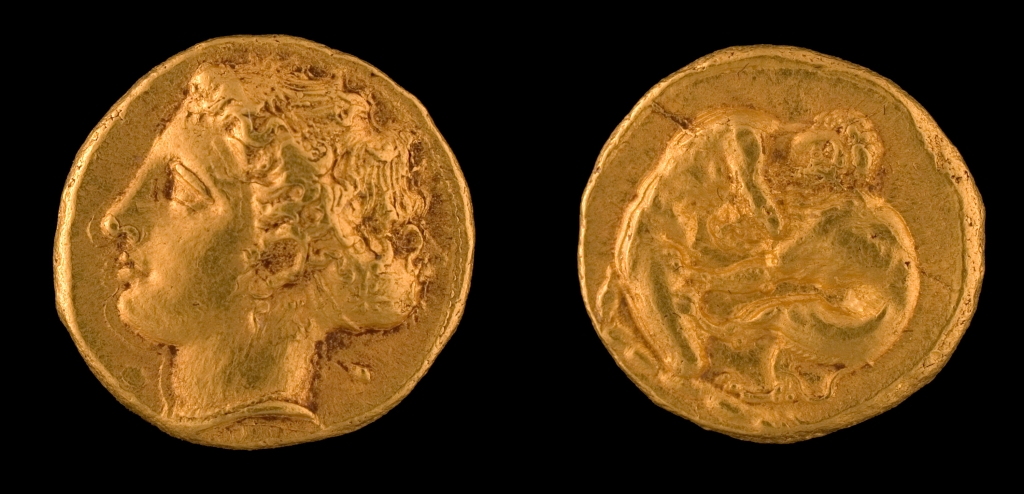
Gold 100 litrai of Syracuse, 5.80 g.
Title
Gold 100 litrai of Syracuse, 5.80 g.
Creator
Syracuse, Sicily, Italy
Date
c. 380-367 BCE
Description
Obverse: Head of Arethusa to left, wearing necklace and earring, hair in sphendone with eight-pointed stars, pellet behind neck. Check. Double-struck.
Reverse: Young nude Herakles kneeling to right, wrestling Nemean lion.
Style/Period: Late Classical Greece
The reign of Dionysios I, the tyrant of Syracuse from 405 until 367 BCE, was marked by almost continual struggles with the Carthaginians for control of Sicily. His large denominations like this gold 100 litrai piece (equivalent to two silver dekadrachms) were probably issued largely for the purpose of paying his mercenaries. Some of these coins were signed by Euainetos (see coin 91.032), but this coin does not bear the signature of the artist. The gold issues are thought to have begun c. 380 BCE, since examples in relatively good condition were found in a hoard in eastern Sicily deposited c. 360 BCE.
The obverse depicts the head of the Syracusan nymph Arethusa, her hair bound in a sphendone or net decorated with stars. The reverse depicting Herakles’ struggle with the supposedly invincible Nemean lion may refer to Dionysios’ struggles with Carthage. The coin is doublestruck, its design pressed into the metal twice, leaving the images on the obverse and reverse blurred and poorly defined.
-- Kelly Swett Riordan, LU '93
Bibliography: G. de Ciccio, Gli aurei siracusani di Cimoni e di Evaneto (Naples 1922) XV, 44, pl. 39; G. Seltman, Greek Coins2 (London 1955) 128; K. Jenkins, Coins of Greek Sicily (London 1966) 29-30; C. Kraay, Archaic and Classical Greek Coins (Berkeley and Los Angeles 1976) 232.
Source
Ottilia Buerger Collection. Ex Santa Barbara Museum of Art. Purchased in Malter auction, March 20, 1975
Identifier
91.034
Rights
Wriston Art Center Galleries, Lawrence University, Appleton, WI,wriston-gallery@lawrence.edu,920-832-6890
Files
Citation
Syracuse, Sicily, Italy, “Gold 100 litrai of Syracuse, 5.80 g.,” Lawrence University Classics Department & Ottilia Buerger Coin Collections, accessed November 5, 2026, https://thor.lawrence.edu/omeka/buerger/items/show/351.