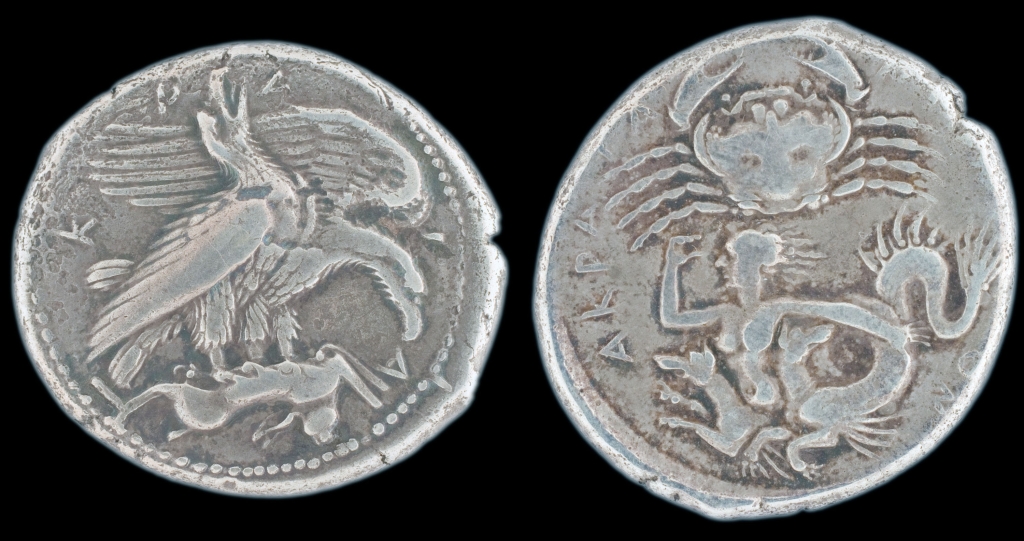
Silver Tetradrachm of Akragas, 16.97 g.
Title
Silver Tetradrachm of Akragas, 16.97 g.
Creator
Agrigentum (Akragas), Sicily, Italy
Date
415 BCE
Description
Obverse: Two eagles standing on supine hare, the farther with spread wings, about to tear the hare, the nearer with closed wings, raising its head and screaming. Α ΚΡΑΓ.
Reverse: Crab and Scylla, her right hand raised, her left arm trailing. ΑΚΡΑ ΓΑ ΝΤΙΝ ΟΝ.
Style/Period: Greek (ancient)
Beginning with the early coins of Akragas, the typical obverse image depicted an eagle, a symbol of Olympian Zeus, who was an important deity in Akragas. Sometime between 420 and 415, the single eagle was replaced by two eagles standing on and devouring a hare. The type depicting two eagles feasting on a hare may have originated as a tribute to the Greek playwright Aeschylus, who had died in 456 B.C.E in the nearby city of Gela; Akragas had been founded in c. 580 B.C.E. as a colony of Gela. In Aeschylus’ Agamemnon, Zeus sends a sign of two eagles devouring a pregnant hare to Agamemnon. An augur interpreted this sign to mean that the brothers Agamemnon and Menelaus would sack Troy (Aeschylus, Agamemnon, 109ff).
The crab on the reverse is a symbol of the city of Akragas. Beneath it is Scylla, the mythological monster who terrorized Odysseus and his men on their journey home from Troy. Scylla was once a beautiful Naiad who was transformed into the terrifying creature shown on the coin, with a female head and torso, a serpent tail, and the foreparts of two dogs. Scylla, along with the whirlpool-monster Charybdis, was believed to have resided in the Strait of Messina, a hazardous passageway between Sicily and Italy. It has been suggested that her presence on these coins may refer to the Syracusan victory over the invading Athenian army during the infamous Sicilian expedition of 415-413 BCE. Akragas, however, seems to have remained relatively neutral during the Sicilian Expedition, so perhaps Scylla is simply meant to signify Akragas’ naval and economic power during this period, which rivaled that of Syracuse.
Max Lavery, LU '17
Bibliography: G.E. Rizzo, Monete greche della Sicilia (Rome 1946) 92, pl. 4, no. 1; A Catalogue of the Greek coins in the British Museum II: Sicily (Bologna 1963) 12, no. 61; C. M. Kraay, Greek Coins (New York 1966) 296, no. 175, pl. 60; K. Jenkins, Coins of Greek Sicily (London 1976) 46-47; N .K. Rutter, The Greek Coinages of Southern Italy and Sicily (London 1997) 149.
Source
Former collection of Ottilia Buerger. Purchased from Harlan J. Berk, Chicago, IL
Identifier
2001.081
Rights
Wriston Art Center Galleries, Lawrence University, Appleton, WI,wriston-gallery@lawrence.edu,920-832-6890
Subject
Greek, eagle, hare, crab, skylla, Agrigentum, Akragas, Sicily, Italy
Files
Citation
Agrigentum (Akragas), Sicily, Italy, “Silver Tetradrachm of Akragas, 16.97 g.,” Lawrence University Classics Department & Ottilia Buerger Coin Collections, accessed November 5, 2026, https://thor.lawrence.edu/omeka/buerger/items/show/345.