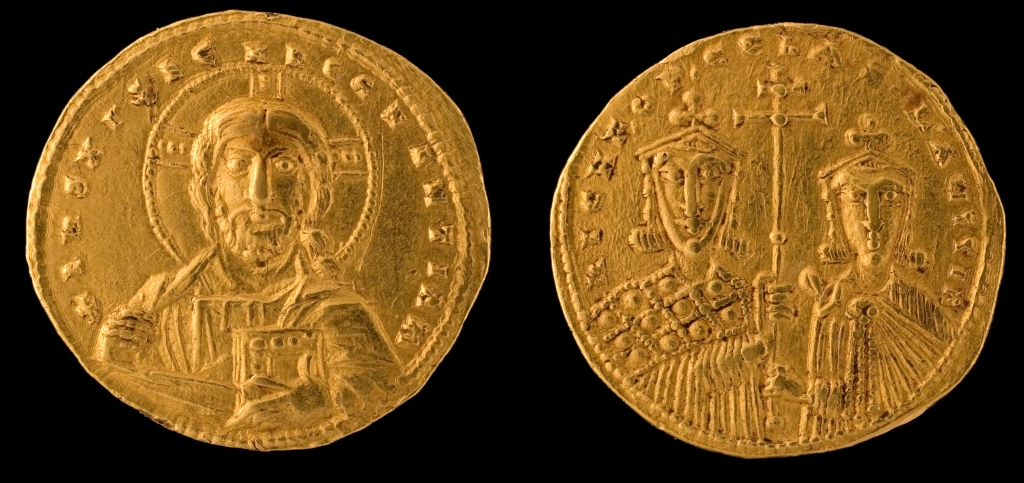
Gold Histamenon of Nicephorus II Phocas and Basil II, 4.35 g.
Title
Gold Histamenon of Nicephorus II Phocas and Basil II, 4.35 g.
Creator
Nicephorus II Phocas, Basil II
Date
963-969 CE
Description
Obverse: Facing bust of Christ with cross-nimbus, right hand raised in blessing, left holding book; IhS(VS) XP(ISTO)S REX REGNANTIVM: Jesus Christ, King of those who rule.
Reverse: Facing busts of Nicephorus on left, wearing loros and crown with cross, and Basil II on right, wearing chlamys and crown with cross, both holding patriarchal cross between them; NICHFOP(VS) CE BASIL AVGG (AVGVSTI abbreviated) B(ASILEIS) R(OMAION): Nicephorus and Basil, Augusti, kings of the Romans.
Style/Period: Byzantine
At the premature death of Romanus II, his mother, Theophano, married the famous general Nicephorus II Phocas in order to ward off threats to her remaining two young sons. He is depicted here with the elder of the two, Basil II, who would eventually become one of the greatest Byzantine emperors. Nicephorus is shown to be the senior emperor by his position on the left, his more elaborate dress, and his slightly larger scale. On the obverse is a depiction of Christ Pantokrator done in a naturalistic style that contrasts greatly with the stylized imperial portraits of the reverse.
During the reign of Nicephorus the gold coinage was divided into two types. The first retained the weight and appearance of the solidus; it would now be called the "histamenon" or "standard," of which this coin is an example. The second was a debased coin called the "tetarteron" or "quarter" owing to its lighter weight (see 91.290). The debasement was probably necessary to finance Nicephorus' ambitious military campaigns.
This coin also demonstrates a gradual change from Latin to Greek in the inscriptions of Byzantine coins, with a sometimes confusing mixture of the two languages on a single coin; here even the spelling of Nicephorus' name uses both Latin and Greek letters.
-- Eric N. Jurgens, LU '93
Bibliography: P. Grierson, Byzantine Coins (London 1982).
Source
Former collection of Ottilia Buerger. Purchased from Abner Kreisberg, October 18, 1960.
Identifier
91.289
Rights
Wriston Art Center Galleries, Lawrence University, Appleton, WI,wriston-gallery@lawrence.edu,920-832-6890
Subject
Byzantine, Christ, cross-nimbus, book, Nicephorus, loros, crown, cross, Basil II, chlamys, Nicephorus II Phocas
Files
Citation
Nicephorus II Phocas, Basil II, “Gold Histamenon of Nicephorus II Phocas and Basil II, 4.35 g.,” Lawrence University Classics Department & Ottilia Buerger Coin Collections, accessed November 5, 2026, https://thor.lawrence.edu/omeka/buerger/items/show/336.